Showing posts with label industry. Show all posts

Sunday, 28 April 2013

"The Genius of Turner: Painting the Industrial Revolution" - a great British documentary


J.M.W. Turner: Bell Rock Lighthouse (1819)
Scottish National Gallery

Great documentaries are the lifeblood of quality television. Although one often has the feeling that the really fine documentaries were done already years ago, it is always nice to be surprised by a new high quality production. 

"The Genius of Turner: Painting the Industrial Revolution", a documentary exploring the influence of the industrial revolution on the life and work of J.M.W. Turner, shown on BBC Two last Friday, was without doubt one of these pleasant surprises. 

I have myself preferred Constable's depictions of British rural scenery, but this documentary, which looked at Turner in a new light, has given me a good reason to reconsider. The visually stunning Fresh One Productions film, directed by Clare Beavan, uses nine of Turner's key paintings as a starting point to show his close involvement with machines, science, technology and industry. The expert commentaries add a lot of interesting information about this less known side of the great painter's production. 

The final words of the documentary are a good summary: 

"This then is J.M.W. Turner, Britain's great romantic landscape painter, who delivered to us a visionary story of the industrial revolution, and at the same time revealed the wonders of science and invention, who used paint to herald a new world." 


J.M.W. Turner: Rain, steam and Speed - The Great Western Railway (1844).
The National Gallery, London


J.M.W. Turner: Dudley (1832)
Lady Lever Art Gallery, Liverpool

J.M.W. Turner
Self portrait


Hopefully this documentary will soon be available on DVD/Blu ray!

PS
There is more on Turner to look forward to: 


Mike Leigh is to direct a film focusing on the life of famed English painter JMW (Joseph Mallord William) Turner.
Timothy Spall has been cast in the lead role of the landscape watercolour artist, who died in 1851 aged 76.
Although considered an eccentric during his lifetime, Turner is now regarded as one of the Britain's greatest painters.
Spall has worked with Leigh on a number of films, including Life is Sweet, All or Nothing and Topsy-Turvy, his 1999 film about Gilbert and Sullivan.
"Turner as a character is compelling," said Leigh. "I want to explore the man, his working life, his relationships and how he lived.
"But what fascinates me most is the drama that lies in the tension between this driven eccentric and the epic, timeless world he evoked in his masterpieces."

Tuesday, 26 February 2013

Gothenburg in the late 1890s

The Vasa street.

The 19th century was a period of fast growth in Gothenburg, Sweden's second largest city. During the second half of the century its population grew from 26,000 to 130,000. Already in the 1840's Gothenburg became the most important port city for imports, and by the end of the 1850's the it also became Sweden's largest export port (mainly timber) . (The Port of Gothenburg is still the largest port in Sweden - and Scandinavia).

Mighty merchant houses, like Dickson & Co, founded by the Scot James Dixon, who had emigrated to Sweden in 1807, soon also became important players in the shipping industry. 

As shipping became more important, also the Gothenburg shipyards experienced a fast growth. Among the other industries, the textile industry was the most important since to middle of the 1850's.  

The affluence brought by the fast growing economy also was reflected in the general development and architecture of the city, as can be seen from these photographs from the end of the 1890's. 

Västra Hamngatan.

The port of Gothenburg, with the customs building in the foreground.

Kungsportsavenyn

The Gustaf Adolf square and the City hall.

The concert hall in the Trädgårdsföreningen (garden society).

Hotel Haglund.

The Cathedral

Östra Hamngatan

The new concert hall (picture from 1905)

Wednesday, 16 January 2013

The 1897 Stockholm General Art and Industrial Exposition

A general view of the exposition area. 
(image by wikipedia)

The 1897 Stockholm General Art and Industrial Exposition was a huge undertaking, and also a major international media event. When the exhibition closed on October 3, having been open since May 15, there had been a staggering 1,5 million visitors. 

The 1897 exposition was the fourth and largest in a series of Scandinavian fairs. This time also Finland and Russia took part. (In order to make the Finnish participation possible, also Russia, of which Finland at the time was an autonomous Grand Duchy, had to be invited). 

Formally the exposition was organized in order to mark the 25th anniversary of King Oscar II's regency. Altogether 3 722 exhibitors took part, displaying a multitude of objects in the 208,000 square meter exposition area in the southern part of Djurgården. Many new technical inventions, like moving pictures and the modern bicycle, were introduced at the fair. 

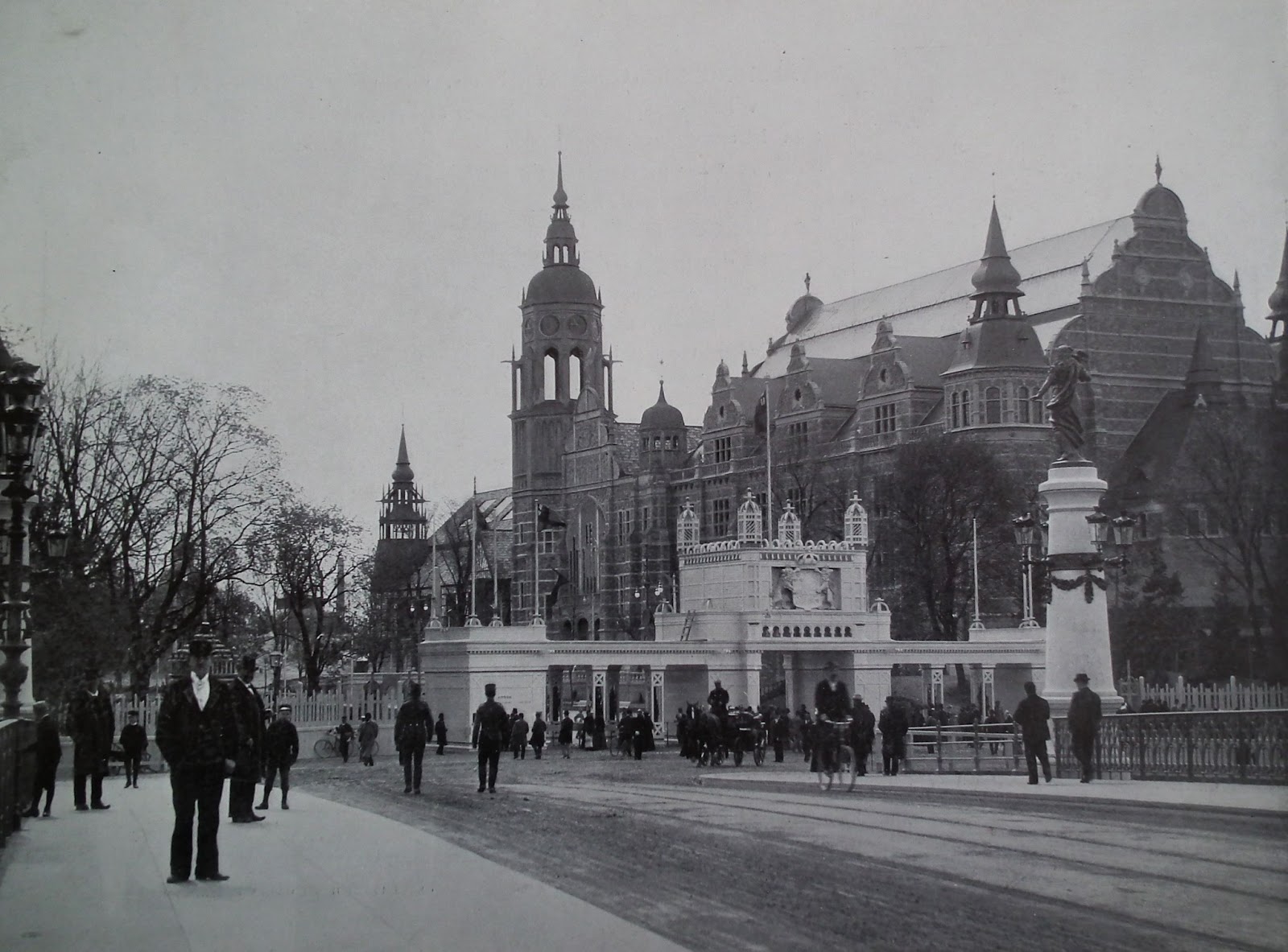
The main entrance, with the Nordiska Museet in the background. Only a part of this new cultural history museum had been completed at the time, but a temporary annex building was added for the exposition.
The exposition area, seen from Strandvägen. The bridge connecting Djurgården with central Stockholm was built for the exhibition. 


The Swedish-Danish "fish hall" (center, left) and "Old Stockholm" were popular among visitors. The huge candle on the right was erected by the Liljeholmen candle manufacturing company. 
The 50 meter high industry hall, with four "minarets", designed by the F. Boberg (the architect in charge of the exposition), was considered to be the grandest of all the about 100 pavilions. 
The forest exhibition hall, also designed by Boberg.
The city of Stockholm's pavilion and the main restaurant building.
The "engine hall" on the left and the pavilions of the Royal Swedish armed forces.
The white art pavilion, designed by Boberg, was considered to be the most beautiful of all the exposition buildings. The statue in front of the pavilion portrays Swedish king Carl X Gustaf. 

Part of the "Old Stockholm" area, showing how the city looked 300 years earlier.