Showing posts with label Germany. Show all posts

Wednesday, 11 September 2019

The German tugboat Karl in the early 1960s

The port of Hamburg tugboat Karl in action, probably in the early 1960s. My colorization of an image in the M/S Maritime Museum of Denmark archive. The museum does not give a date, but the ship in the background seems to indicate that the photo by an unknown photographer was taken in the early 1960s. The Hamburg shipyard Johannes Ölkers built the ship in the early 1960s for the
 P & A shipping company. 


Tuesday, 7 January 2014

The meeting between Tsar Nicholas II and Kaiser Wilhelm II in the Gulf of Finland in July 1905

Tsar Nicholas II on board Kaiser Wilhelm's yacht Hohenzollern in 1905.

This photograph shows Tsar Nicholas II arriving at Kaiser Wilhelm II's yacht Hohenzollern on July 23, 1905. On the following day the Tsar signed the Treaty of Björkö (in Finnish Koivisto), a secret mutual defense accord with the German Empire, a treaty which was never to be ratified by the Russians. (And as a matter of fact the treaty was also rejected in Berlin.)

Below is an account of the event from Lamar Cecile's excellent book Wilhelm II: Emperor and Exile 1900 - 1941:

"At the end of October 1904, Wilhelm supplied the tsar with a draft alliance, and this led to a flurry of exchanges between the two sovereigns. What emerged from these negotiations was a treaty in which both powers provided the other with military aid in the event either was attacked in Europe or elsewhere. Nicholas, however, was unwilling to commit himself without first consulting his French allies, and Wilhelm's insistence that confidences were properly to be shared only between princes or rulers made no impression on the tsar. The matter therefore lay in abeyance as 1904 turned into 1905. The new year, however, brought a series of grave reverses for Nicholas II: the loss of Port Arthur on 2 January 1905; the colossal defeat of the tsar's Manchurian army at Mukden early in March; and finally, on 27 May, the annihilation in the Sea of Japan of the Russian fleet, which was laboriously making for Port Arthur. In addition, at the end of January 1905, Russia had exploded in what the Kaiser called the "Jew Revolution". Nicholas II's ability to resist Wilhelm's importuning to enter into an alliance was therefore considerably weaker than it had been during their negotiations in the fall of 1904, and he agreed to meet the Kaiser off the island of Björkö in the Gulf of Finland. After the Hohenzollern and the tsar's Polar Star dropped anchor off Björkö on 23 July 1905, Nicholas boarded the German yacht for dinner, in an unusual show of affability, stayed until 3 o'clock in the morning. He assured Wilhelm II, that with the Maroccan crisis defused by Delcassé's fall, there were no further barriers to Franco-German accord. Moreover, the tsar declared that he would never enter into an entente with England, most specifically not one directed against Germany. At nine the next morning, Wilhelm boarded the Polar Star, and he and the tsar retired to Nicholas II's cabin to affix the signatures to the so called  Björkö treaty."                                                   
   
However, as mentioned above, the Björkö Treaty was never ratified:

Although the treaty was signed by the Tsar, it was inevitably a "dead letter" because of Russia's commitment to France. The Russian statesmen Sergey Witte and Vladimir Lambsdorff, neither present at the yacht nor consulted beforehand, insisted that the treaty should never come into effect unless it was approved and signed by France. The Tsar gave in to their pressure, much to the consternation of the Kaiser who did not fail to reproach his cousin: "We joined hands and signed before God, who heard our vows!... What is signed, is signed! and God is our testator!" 

Wednesday, 1 January 2014

The Best European 2013-2014 New Year's Concerts: The Dancers of the Wiener Staatsballet "stole the show"

Dancers from the Wiener Staatsballett

The televised New Year's concerts from the Berlin Philharmonie, the Dresden Semper Oper, the Vienna Musikverein and La Fenice in Venice are the eagerly awaited best "delayed Christmas presents" for music lovers in Europe and many countries on other continents.

This year was no exception. All four concerts were wonderful in their own way.


Sir Simon Rattle

The Berliner Philharmoniker under Sir Simon Rattle have been doing their "own thing" quite successfully for years now. The Philharmoniker web page describes it in this way:

For classical music fans, jaunty dance rhythms are just as much a part of New Year’s Eve as the sound of corks popping and fireworks. But need it be waltzes from Vienna, the city on the Danube, ringing in the New Year? By no means, according to the Berliner Philharmoniker and Sir Simon Rattle – and they traditionally programme different music for their New Year’s concerts along the river Spree.

The highlight of the Berlin New Year's Eve concert this year was Sergei Prokofiev's Third Piano Concerto, with the Chinese virtuoso Lang Lang as the brilliant soloist. The entire evening was a great success, with the Philharmoniker and Sir Simon in top form.

Klaus Florian Vogt, Renée Fleming and Christian Thielmann

The Staatskapelle Dresden's "competing" New Year's Eve concert has during the last few years focused on operetta music. The fact that Christian Thielemann, the orchestra's eminent chief conductor, is a self-confessed lover of operetta, is of course a god sent gift to all of us who share his passion.

This year's concert was another smash hit, with the wonderful, velvet voiced Renée Fleming as the highlight of the evening. What an entertainer this multitalented lady is! She certainly knows how to charm an audience. German star tenor Klaus Florian Vogt was as good as was to be expected, and sounded great also in the duets with Fleming.

The Vienna New Year's concerts do not need any introduction. The Wiener Philharmoniker's concert on January 1 is the world's most famous and well known annual music event. I belong to those who in the 1960s and 1970s always looked forward to see the legendary Willi Boskovsky conduct the Vienna concerts on television.

Since1986 the orchestra musicians have chosen a different conductor every year. This year it was great to see maestro Daniel Barenboim in charge of the orchestra, which - as always - sounded great.

But for this "reviewer" the greatest stars of the event were the dancers from the Wiener Staatsballett: Maria Yakovleva, Nina Poláková, Irina Tsymbal, Ketevan Papava, Prisca Zeisel, Kirill Koundraev, Mihail Sosnovschi, Ene Peci, Kamil Pavelka and Alexis Forabosco.

I have never seen more beautifully danced and choreographed concert performances than the ones in this New Year's concert. Kudos to Ashley Page for the choreography! An the dresses by Vivienne Westwood were gorgeous.

Diego Matheuz at the La Fenice New Year's concert

The last of the New Year's concerts was the one from La Fenice, broadcast on ARTE in the evening of January 1. This year the orchestra's young chief conductor Diego Matheuz had chosen a nice mix of well known, mainly Italian opera music by RossiniVerdi, Bellini, Puccini, Mascagni and Donizetti for the concert. It was again a memorable evening of bel canto from one of the world's most beautiful opera houses. The two soloists, Italian soprano Carmen Giannattasio and American tenor Lawrence Brownlee, were excellent.


 The wonderful dancers of the Wiener Staatsballett


Suddenly the dancers turned into a painting! It was magical television!


Sunday, 1 December 2013

"Music for the Advent Period" from Dresden on German ZDF: Russian soprano Julia Lezhneva was the star of the evening


The Dresden Music for the Advent Period concerts have been broadcast on German
ZDF since the year 2000.

The Music for the Advent Period concert from the Dresden's beautifully restored Frauenkirche, broadcast by German ZDF on the First Sunday of Advent, has for years now been a wonderful beginning of the Christmas music season on television. The concert today was no exception, even without Chief Conductor Christian Thielemann this year conducting his fine Sächsische Staatskapelle Dresden.


Markus Poschner made his debut with the Staatskapelle Dresden.

Due to the sudden illness of Franz Welser-Möst, who was scheduled to conduct the Advent concert this year, the Generalmusikdirektor of the Bremen Philharmonic, Markus Poschner, was the "master of ceremonies", and he did it very well, indeed.

American mezzo soprano Joyce DiDonato - one of the most sought after mezzos in the world - gave a commanding rendition of Pietro Mascagni's Ave Maria, and I also enjoyed the singing of German tenor Klaus Florian Vogt.


Soprano Julia Lezhneva in front of the Staatskapelle Dresden.

However, for me the young Russian soprano Julia Lezhneva (she is only 23!) was the "star" of the evening. I had never heard her before, but listening to her singing Tu virginum corona and Alleluia from Mozart's Exultate, Jubilate, made it easy to understand why she has been blessed with so much critical acclaim despite of her young age.


Julia Lezhneva sings like an angel!

And it is not only the beauty of Julia Lezhneva's voice, but her entire personality that mesmerizes audiences. She sings - and even looks - like a little angel, without the slightest trace of diva behaviour, which is so common among many of her older, more well known colleagues. One can only hope that she stays this way!


The Kammerchor der Frauenkirche Dresden (The Frauenkirche chamber chorus) also deserves high marks. Their sensitive singing and beautiful phrasing greatly contributed to the success of the evening.

PS

Here is a video for those who are not familiar with the captivating voice of Julia Lezhneva:


Friday, 22 November 2013

The Musikantenstadl - A wonderful German language popular folk music television program


The Viennese born singer and entertainer has since 2006 hosted the Musikantenstadl.

When it comes to music, I'm pretty much a "omnivore", although I nowadays mainly listen to classical music and opera. One of may favourite televised music entertainment programs outside of the classical genre is the German language popular folk music show Musikantenstadl, broadcast live on three European TV channels, ORF1, Das Erste (ARD) and SRF1.

The Musikantenstadl owes much of its popularity to its presenter, the Viennese-born
singer/entertainer Andy Borg, who has hosted the show since 2006. Borg's good natured down-to-earth style clearly makes both live and television audiences feel at home.

The latest Musikantenstadl, broadcast live from the St. Jakobshalle in Basel on November 16, was a joy to watch. Among the many talented popular musicians and other guests, my own favourites were the three young Swiss sisters Geschwister Weber and the precision drum corps Top Secret Secret Drum Corps from Basel.

Geschwister Weber from the Swiss canton Basel-Landschaft.
 
Sandra Weber

The Top Secret Drum Corps from Basel - one of the best precision drum corps
in the world.

Carlo Brunner (on the left) and his Superländlerkapelle were one of the bands
appearing at the Musikantenstadl in Basel.


The lively audience enjoying the evening in Basel.

The ski lodge set with tables on the floor.

 Presenter Andy Borg

Wednesday, 30 October 2013

Three German Navy Gepard class speedboats and tender Elbe going northwards in Øresund


This afternoon three German Navy Gepard class (143 A) speed boats - Gepard S71 (P6121), Ozelot S78 (P6128) and Hermelin S73 (P6123) -  were going northwards in Øresund, followed by their tender Elbe (A511).
 
Four 3.300 kW diesel engines give the 57.6 x 7.8 m speedboats a top speed of 40 knots (about 74 km/h).  The home port for the Gepard class speedboats is Warnemünde.
 
Hermelin S73 approaching Helsingør.

Hermelin with the coast of Danish Zealand in the background.

Gepard a few kilometres north of Helsingør.

Ozelot with a foggy Danish coast in the background.

The 100,55 m / 15,4 m / 4,05 m Elbe provides fuel for the thirsty speed boats.
Another picture of the Elbe in the Sound.

Here you can watch the Gepard S71 in action:

Thursday, 17 October 2013

German fishery research vessel Solea in Øresund

The German fishery research vessel Solea was yesterday afternoon going northwards in Øresund. The 42.74 m x 10 m ship is one of three research vessels managed by the German Federal Office for Food, Agriculture and Consumer Protection. Solea's home port is Cuxhaven.


Solea approaching Helsingør.

Solea and Kronborg castle.

Solea, which entered service in 2004, is used by the Johann-Heinrich-von-Thünen-Institute and
by the Max-Rubner-Institute for research on fishery resources and catch technical examinations.

Tuesday, 15 October 2013

German schooner Grossherzogin Elisabeth in Øresund

Yesterday afternoon the German 3-mast schooner Großherzogin Elisabeth looked great when it was sailing northwards in Øresund.

Grossherzogin Elisabeth  approaching Helsingør.


A backlight image of "Lissi", just before Kronborg castle.

A Grand Duchess and Hamlet's Kronborg castle.


Sailing northwards in the Sound.
 
The 63.70 m x 8.23 m "Lissi", as she is amicably called, has an interesting history:

  • built on order of the Dutch shipowner Andreas Hammerstein at the shipyard
    of Jan Smit in Alblasserdam as 3-masted schooner with collapsible masts
    and auxiliary engine, launched on August 19th, 1909 and christened the
    "San Antonio".
  • used between 1910 and 1913 as freighter to the Mediterranean, South America
    and in the North and Baltic Sea.
  • run aground on January 25th, 1914 at the coast of Morocco near Rabat,
    however she came free with the help of her machine.
  • capsize in winter 1929 with a timber cargo load next to Copenhagen, she
    could be salvaged and get on the road again.
  • 1936 converted to a motor coaster with a new engine and an auxiliary rig
  • at outbreak of the war the owner flew on board the ship to England,
    since 1940 she has been to transport evacuees and for reinforcements
    in the allied convoys.
  • 1947 sold to Swedish owners, renamed the "Buddi", used as supplyer
    for Swedish towns on the coasts following several changes of the owner
    and the renaming to "Santoni".
  • bought by captain Hartmut Paschburg from Hamburg in August 1973, she was
    in a poor and neglected condition, rebuilt at the shipyard van Kroosz in
    Wischhaven and the shipyard in Stade, conversion to a 3-masted schooner
    for cruising the Mediterranean and Caribbean, renamed the "Ariadne",
    has been used as sailing cruiser until autumn 1981.
  • found by shipowner and captain Horst Werner Janssen from Elsfleth/GER
    in the port of Pireßs in October 1981, who chartered the ship and
    transported her to Elsfleth, in January 1982 the organization "Schulschiffverein
    Großherzogin Elisabeth" e.V. was founded, renaming of the ship to
    "Großherzogin Elisabeth" after a former sailing schoolship based in the
    town (the today's "Duchesse Anne").
  • in June 1983 the administrative district Wesermarsch bought her with the
    finacial help of the federal state Niedersachsen and the town Elsfleth,
    used for educational voyages in the North Sea and Baltic Sea and as a
    as a floating boarding school for young seamen in winter time in the
    following years.
  • 1993 a heavy fire caused by welding during a overhaul in the shipyard of
    Elsfleth damaged the ship, with great commitment of the Schulschiffverein
    and other sponsors these damages could be repaired, she became the
    property of the Schulschiffverein "Großherzogin Elisabeth".


  • Thursday, 3 October 2013

    The fight aganist "King Alcohol" in Berlin 1905

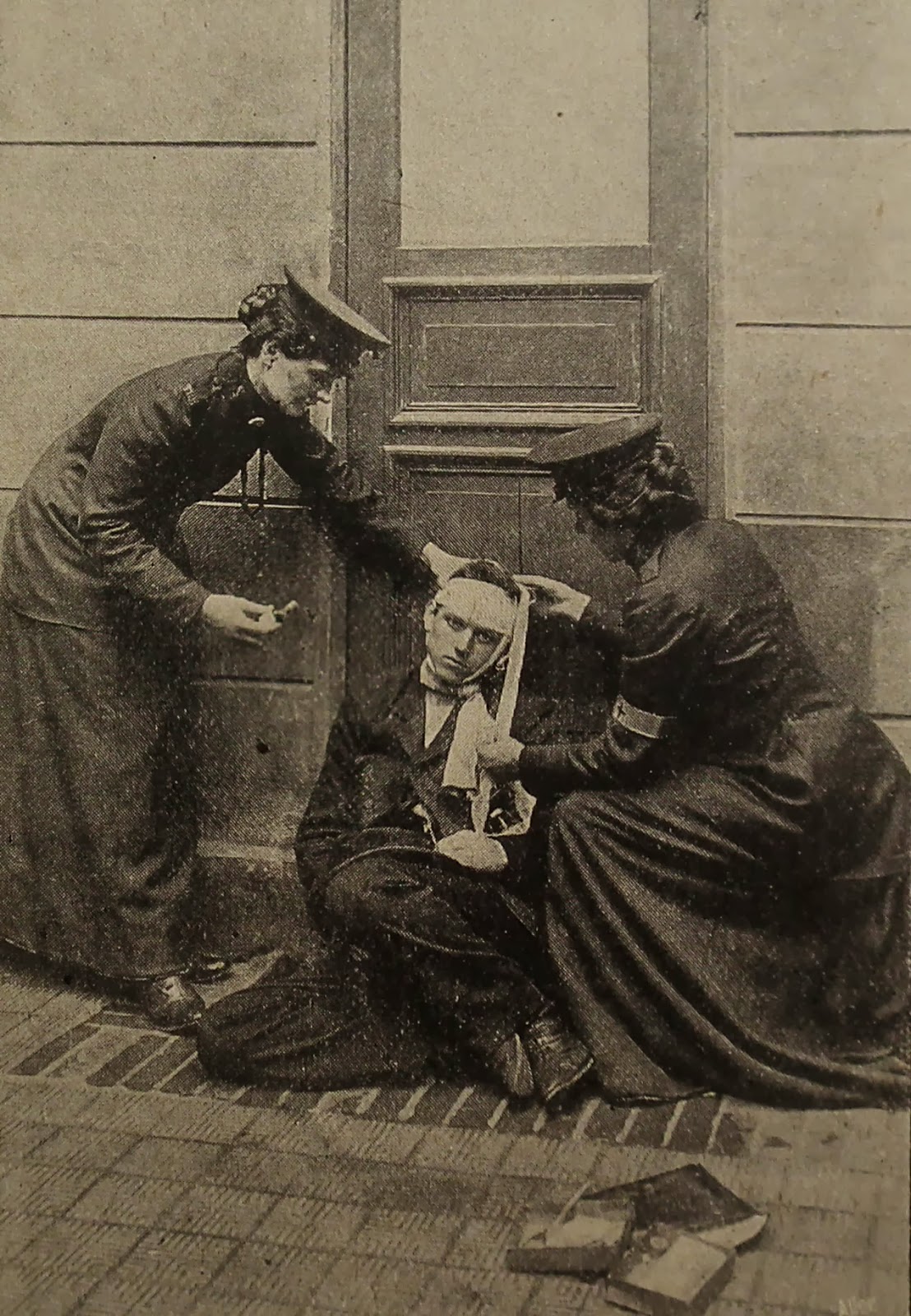
    Heavy drinking is a major problem in many European countries - as it was already in the  beginning of the 20th century. This photo from 1905 shows members of the newly founded Salvation Army brigade in Berlin ready for action:


    Two Salvation Army members taking care of a drunkard in Berlin in 1905:

    Monday, 15 July 2013

    The Porsche thousands of ordinary Germans could afford already 50 years ago

    Today most people associate Porsche with fast sport cars that only rather well to do people can afford. However, already in the difficult post war reconstruction years, thousands of ordinary Germans  drove a Porsche - albeit a Porsche tractor

    The initial design and production of Porsche tractors began already in 1934. After the war there was of course a growing demand for tractors, and in 1956  Porsche-Diesel Motorenbau GmbH, a wholly owned subsidiary of Mannesmann AG, built a new production facility in Friedrichshafen-Manzell at the old Donier/Zeppelin factory.

    However, already in the end of 1963 the last Porsche tractor left the production line, as Mannesmann decided to discontinue tractor manufacturing.

    In 1958, when the 14 hp Porsche Junior model shown in the pictures below left the factory, altogether 20,000 tractors were made in Friedrichshafen-Manzell. 


    This 1958 Porsche Junior belongs to a collector in Helsingborg, Sweden.

    The look of a 1958 Porsche.

    From the driver's seat.

    A young Swedish Porsche driver.

    Friday, 5 July 2013

    The historic pilot schooner No.5 Elbe sailing in Øresund


    Pilot schooner No.5 Elbe sailing northward in Øresund last night.

    The pilot schooner No.5 ELBE is the last remaining ship from the era of wooden ships in Hamburg. The ship, built by Werft von H.C. Stülcken in 1883, served pilots on the Elbe and the German Bight  for 30 years. Then it was used as a private yacht, making 13 Atlantic crossings and even rounded the Kap Hoorn. In 2002, the foundation Stiftung Hamburg Maritim, acquired the ship in Seattle, and brought it back to Hamburg. The meticulously renovated and maintained No.5 Elbe can now be chartered for day trips (up to 35 guests) and longer journeys (12 guests). The ship's homepage contains a lot of interesting information (in German). 


    Here the No.5 Elbe has just passed Kronborg castle.


    The No.5 Elbe meets the small cargo ship Hagland Boss in the Sound.
    PS
    At the time of my writing this, the No.5 Elbe is in the Kattegat on its way to Varberg.