Showing posts with label Scotland. Show all posts

Wednesday, 17 July 2013

The Japanese steamer Hakata Maru and its commander in 1904

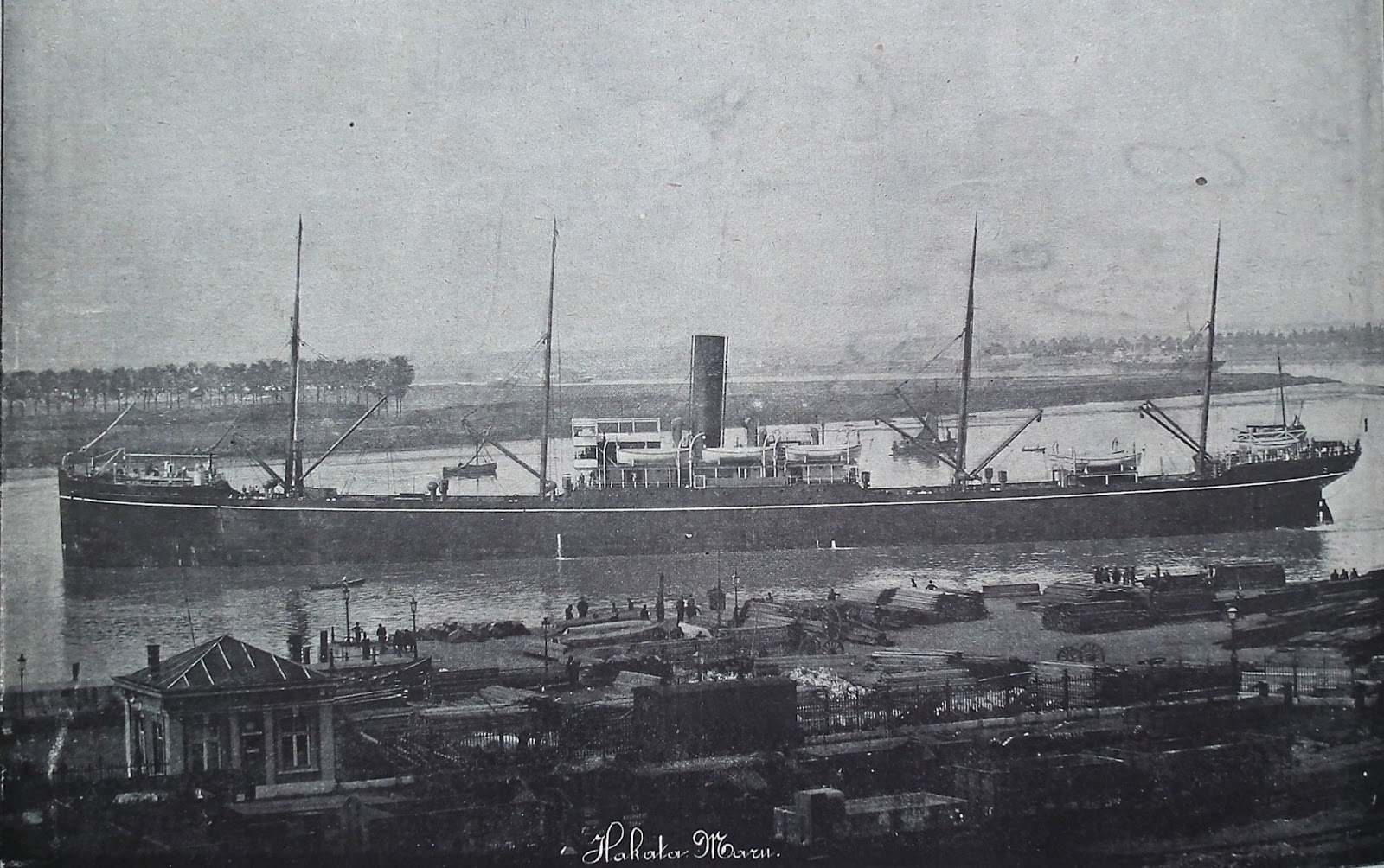
Recently I found these two 1904 photographs of the Japanase cargo/passenger vessel SS Hakata Maru and its commander, captain Sommer:


The Hakata Maru in 1904. Where to photo was taken, remains unknown to me. 

Captain Sommer (a German?), the commander of Hakata Maru in 1904.

With the help of a little googling, I was able to find some additional information on the ship on the web:

The Hakata Maru was launched in 1897 at David and William Henderson & Co., Glasgow, for N.Y.K (Nippon Yusen Kaisha) Line's new European service. The 6161 gross tons, 135.6 m x 15.5 m ship had steam triple expansion engines, twin screw. Service speed was 12 knots. 

The Hakata Maru, named after Hakata, one of the oldest cities in Japan (now part of Fukuoka) was scrapped in 1933. 

Recently this painting of the Hakata Maru was sold for $3,675 at a US auction house:


Saturday, 27 April 2013

The expedition cruise ship M/S Quest on its way to Scotland

M/S Quest in Øresund yesterday on its way to Oban.

The small (50m x 11m) expedition cruise ship M/S Quest yesterday left Helsingborg, where it has spent the winter months. The ship is now on its way to Scottish Oban, from where it will begin its first cruise of the season (to The Hebrides and St. Kilda) on May 7.

M/S Quest in the port of Helsingborg in March.

 Later on this year the Quest's itinerary includes cruises to Lofoten, Bear Island and Svalbard. The vessel's relatively small size allows her to reach places where larger ships cannot go. There are just 26 cabins on board, with beds for maximum 53 passengers.

The Quest has an interesting history: It was built in Denmark in 1992 to serve as a ferry on Greenland's west coast. In 2004/2005 she was was completely refurbished and converted to a small expedition cruise ship.

Tuesday, 15 January 2013

Stora Sundby - "The Swedish Abbotsford"

Stora Sundby, "the Swedish Abbotsford", in a late 19th century photograph. 

The books of Sir Walter Scott made him and his Abbotsford House well known all over the world. Sweden was no exception.

When the rich nobleman, count Carl de Geer in 1824 bought the 16th century manor Sundby Hus at lake Hjälmaren in Södermanland, his wife, who had read Scott's novels about the noble knight Ivanhoe, wanted their new home to be converted to a "Swedish Abbotsford". 


The count did not want to disappoint his countess, which is why an English architect, Peter Frederick Robinson, was commissioned to redesign the old manor in the style of Abbotsford. The conversion was not an easy task, which is why it took 16 years to complete. But in 1848 the new "romantic knight's castle" was finally inaugurated. 


The house, renamed Stora Sundby (Great Sundby) by de Geer, is now the home of Johan and Tina Klingspor and their children.   


For a comparison, here is a late 19th century photo of the real Abbotsford, which became a model for the modern revival of the Scottish baronial style:


Thursday, 8 November 2012

Sir Walter Scott's stunning Abbotsford in the late 19th century

Sir Walter Scott's stunning home Abbotsford in the 1880s.

This is AbbotsfordSir Walter Scott's stunning home, photographed in the 1880s. The romantic castle, designed by the first English-language author to have a truly international career, is since 2007 in the care of The Abbotsford Trusta charity created to safeguard the future of the estate and the legacy of Sir Walter Scott. 

This is how the trust defines its task and the house it safeguarding:

 The trust is determined to restore the house and redevelop the estate in order to make it self-sustaining. It is the objective of the trustees to ensure that Abbotsford becomes the centre of a renaissance of Scott’s works, but in a way that a modern audience will appreciate.
-

Perhaps nowhere else in the world can evoke the power of the romantic past more than Abbotsford, stunningly located on the banks of the River Tweed in the Scottish Borders. Abbotsford sits at the heart of the landscape that inspired the poetry and novels of its creator, Sir Walter Scott. Unlike the homes of other great writers, this is a house that the writer himself designed and as such uniquely embodies a physical representation of the Romantic Movement that he helped to create. When you touch the bricks and mortar of Abbotsford, you are touching the soul of Scott.
The house contains an impressive collection of historic relics, weapons and armour, including Rob Roy’s gun, dirk and sword, and an extensive library containing over 9,000 rare volumes. It sits amid formal gardens and a wider landscape that Scott designed and planted.

Here you can read more about The Abbotsford Trust. 

Monday, 2 April 2012

Whisky Galore!

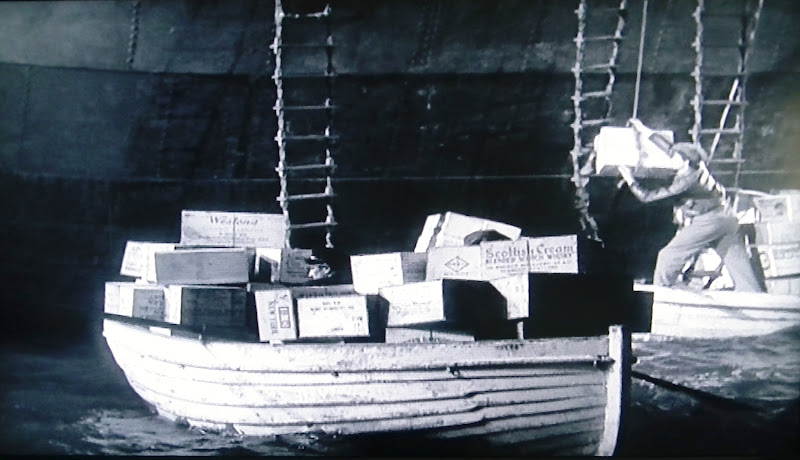
The "rescue operation" in full swing


On a rather chilly and windy day here in the Øresund area, what could more enjoyable than watching the 1949 Ealing comedy film Whisky Galore! based on the novel by Compton MacKenzie - of course accompanied by a glass of my favourite single malt, Bowmore from the Isle of Islay in the Hebrides


Basil Radford  as Captain Paul Waggett, the stuffy English commander of the local  Home Guard

The movie and the novel are based on the real-life 1941 shipwreck of S.S. Politician near the island of Eriskay (in the movie renamed Todday) in the Hebrides, and the islanders´ unauthorized taking of its cargo of whisky. Before that the island had run out of whisky, which resulted in a deep gloom among the natives. The shipwreck loaded with 15.000 bottles of whisky came almost as a gift from heaven ....

Whisky Galore is one of the great Ealings comedies, as enjoyable today as 60 or so years ago. Strongly recommended, especially for friends of good Scotch whisky! 

Natives celebrating the "catch"
James Robertson Justice as Dr. Maclaren


PS

On the subject of whisky, it is good to know that original Scotch whisky is doing rather well internationally now: 


Scotch Whisky exports grew to a record £4.2bn last year as younger drinkers in emerging markets developed a taste for the tipple.
The Scotch Whisky Association, which announced the figures today, said rising demand in developing and mature markets had helped export values rise an average of 10% a year over the past five years.
Exports to the US, the biggest market by value, rose 31% year-on-year to £654.9m – breaking the £600m barrier for the first time. Sales to France, the second biggest market, grew 27% to £535.4m.
Hopefully the single malts from the Hebrides have their share of the success!