Showing posts with label China. Show all posts

Wednesday, 15 February 2017

Primula against a Chinese background

I thought the Primula looked good against the Chinese carpet ... :-)


Saturday, 14 January 2017

Lychees - once favourites of the Imperial Court in China

Lychee fruits were once favoured in China, particularly by the Imperial Court:

In the 1st century, fresh lychees were in such demand at the Imperial Court that a special courier service with fast horses would bring the fresh fruit from Guangdong. There was great demand for lychee in the Song Dynasty (960-1279), according to Cai Xiang, in his Li chi pu (Treatise on Lychees). It was also the favourite fruit of Emperor Li Longji (Xuanzong)'s favoured concubine Yang Yuhuan (Yang Guifei). The emperor had the fruit delivered at great expense to the capital. (Wikipedia)


Friday, 23 December 2016

Friday, 20 December 2013

High level British export promotion trips to China - 2013 and 1793

The Emperor of China receives Lord Macartney, the leader of the British export
promotion "trip" to Peking in 1793. (source: wiki)

High level export promotion trips to China are nowadays a common sight in Peking (Beijing). The visiting dignitaries always bring presents in order to impress their Chinese hosts.

When David Cameron a couple of weeks ago visited China together with 131 top business people and other delegates, his choice of presents was criticized by a writer in the Guardian:

Cameron in China: why does he always give foreign leaders rubbish presents?

The prime minister gave the Chinese premier Le Keqiang some books, a pair of gloves and a tennis racket, among other things. Then again, he's never been the most imaginative gift giver.

Maybe Cameron should have studied the gift list of a previous (1793) high level export promotion trip to China:

Here is the list of presents to the His Imperial Majesty, published in the book "The Historical Accound of The Embassy to the Emperor of China undertaken by order of the King of Great Britain", written by Sir Georg Staunton, "Secretary of Embassy to the Emperor of China, and Minister Plenipotentiary in the absence of the Ambassador":

"The presents consisted of an orrery (mechanical model of the solar system), a reflecting telescope, a celestial and a terrestrial globe, several chronometers or time pieces, an air pump, a machine exhibiting the mechanic powers, five pieces of brass ordnance, muskets, pistols, sword blades, a complete model of a first rate man of war of a hundred an ten guns, ornamental vases, various kinds of earthen ware, a large burning glass, a pair magnificent glass lustres, specimens of the  productions of the manufactures of Great Britain in wool, cotton, steel and other metals, representations of several cities, towns, churches, seats, gardens, cattles, bridges, lakes, volcanos, and antiquities, of battles by sea and land, dock yards or places for building ships, horce races, bull fighting, and of most other objects curious or remarkable in the dominions of his Britannic Majesty, and other parts of Europe; also of some of the most eminent persons, including the Royal family of Great Britain; the representations themselves being monuments of the arts by which they are made in their present advanced state."

The transportation of the British presents was no easy task. Here is Sir George's account:

"The presents and baggage, which hitherto had come by water, were now to be conveyed by land to the Emperor's autumnal palace. Such as were liable to receive damages by jolting of vehicles without springs, were destined to be carried by men; and from a pretty nice calculation it was found, that about ninety waggons, forty hand barrows, two hundred horses, and nearly three thousand labouring men would be wanted for this business."

This is how the British presents were transported.
(Illustration from the book by Sir George Staunton, published in London 1797)


"In China, bulky and heavy packages are carried by men. To each side of the load are fixed two strong bamboos. If four men (two to each bamboo) be not equal to its weight, two other bamboos, shorter than the first, are fastened to the extremities of each of the original long ones. These eight extremities are brought to rest on the shoulders of eight men, as described in the annexed plate. More bamboos being affixed to these, in a geometrical proportion, each of who would sustain an equal degree of pressure on raising or carrying ponderous packages."

The delegation itself had other means of transportation:

"The Ambassador and three gentlemen of his suite travelled in sedan chairs; the other gentlemen, and all the Mandarins, on horseback."

The type of "Sedan chair" in which Lord Macartney and "three other gentlemen of
his suite travelled".


The presents appear to have been well received:

"In the interim very flattering messages were conveyed to his Excellency, expressive of the great satisfaction which the presents gave to his Imperial Majesty."

PS

In spite of all the efforts, the 1793 mission, led by Lord Macartney, was apparently not quite as successful as the British had hoped for:

"The embassy was ultimately not successful in its primary objectives, although the circumstances surrounding it provided ample opportunity for both British and Chinese parties not to feel totally disgruntled about the compromises and concessions they had made. The failure of the primary objectives was not due to Macartney's refusal to kowtow in the presence of the Qianlong Emperor, as is sometimes believed. It was also not a result of the Chinese reliance on tradition in dictating foreign policy, but rather a result of competing world views which were uncomprehending and to some extent incompatible. After the conclusion of the embassy, Qianlong sent a letter to King George III, explaining in greater depth the reasons for his refusal to grant the several requests presented to the Chinese emperor by Macartney." --

"Emperor Qianlong's letter's continuing reference to all Europeans as "Barbarians", his assumption of all nations of the earth as being tributary to China, and his final words commanding King George III to "...Tremblingly obey and show no negligence!"[10] can be interpreted as a challenge or as a imperious dismissal."

(bolding by NNoN)

Wednesday, 24 April 2013

A Swedish-British rescue expedition during the 1911 revolution in China

The members of the Swedish-British expedition for the relief missionaries in  Shensi (from  left to right):
Keyte, Fairburn, A. de C. Sowerby (leader), E.T. Nyström (vice leader), E.R. Long, Denver-Jones, Ewans, Warrington,  W.M. Palmer. 

The Revolution of 1911 to overthrow the last imperial dynasty, the Qing, led to unrest and uprisings in many parts of China. Reports about the killing of a number of  missionaries (some of them Swedish) in the country's interior were worrisome reading for western diplomats based in Peking.

Swedish Minister G.O. Wallenberg posing at the barricade in front of the U.S. embassy  in Peking.

The Swedish Minister, Gustaf Oscar Wallenberg, was a leading force in the efforts to send a Swedish-British "expedition for the relief of the missionaries in Shensi". The nine man expedition, led by A. de C. Sowerby, began its journey on horseback on December 4 at Tai-Yuan-Fe, the end station for the railway in the Shansi region.

The second in command, professor E.T. Nyström (a Swedish geologist at the Shansi Government University), later wrote about the difficult rescue mission in the Swedish weekly "Hvar 8 Dag":

"At the clubs in Peking and Tientsin, the bets were one against one that we would never return. The distances are such, that for the sake of comparison you could imagine that Norway would be in a state of anarchy and we would rescue people in Bergen and Trondheim riding on horseback from Stockholm."

After a difficult journey - which included encounters with groups of "armed desperados", the caravan finally arrived in Si-An-Fu, the capital of the Shensi province, where "the expedition was very pleased to see a great number of missionaries waiting to be escorted to the coast".

"In Si-An-Fu we saw appalling traces of the revolution: the entire Manchu city had been destroyed by fire, many bones and skulls of the 15.000 who had been killed. The ruins of the Swedish school was visited. The marks in the walls, where the poor people were had tried to escape before they died, were a horrendous sight."   

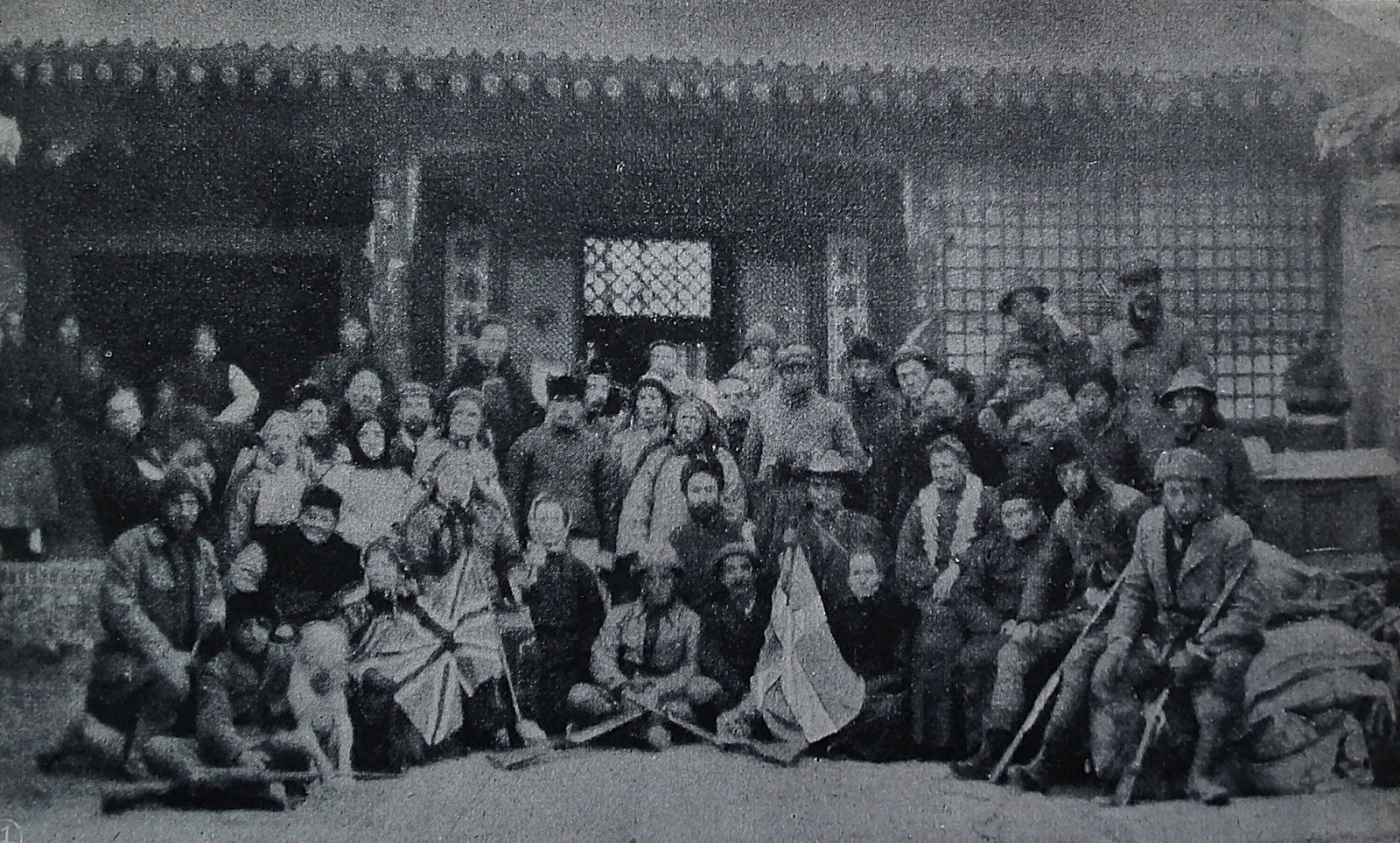
The members of the rescue expedition together with the rescued missionaries.

In early January the caravan, consisting of 135 persons, 90 animals, arrived in Tai-Yuan-Fe, where the British minister had organised a special train to take it to Peking. Each member of the expedition later received a thank you letter from the Swedish and British ministers for rescuing 13 Swedish and 19 British missionaries:


PS

Even in the middle of a dangerous and difficult rescue mission, the members found time to celebrate Christmas properly. Professor Nyström writes that the caravan stopped for a day, and a delicious meal, consisting of 11 courses, was prepared. "Palmer and I had to ride 40 km in order to find a Christmas tree, and because we did not have an ax, the fir tree was cut by the shots of a revolver!".

Monday, 31 December 2012

Ships in Shanghai on New Year's Eve

The world's busiest port, the port of Shanghai, was full of ships also on New Year's Eve. This was the view about 11 PM on the Marine Traffic map (showing only part of the Shanghai area):


The crew of the Danish owned 318 x 42 m container ship Maersk Kotka - on its way to Pusan new harbor - were among the sailors celebrating the new year far away from home.

Happy New Year to all of you on board the Maersk Kotka, and all other ships in different locations!

Monday, 5 November 2012

Marshal Gustaf Mannerheim's ethnographic photographs

"Dancing Kalmucks"
During and after Finland's struggle for independence Marshal Gustaf Mannerheim - the greatest Finn of all times - was Commander-in-Chief in in three wars and twice Head of State. During the heroic 105 days of the Winter War (1939-1940), when Finland fought alone against Stalin's Red Army, Mannerheim was hailed as a champion of liberty throughout the western world.

Before joining Finland's fight for independence Mannerheim was a succesful General in the Russian army (until 1917 Finland was an autonomous Grand Duchy within the Russian empire). The fact that he was an able sportsman and and wellknown for his excellent horsemanship must have been one of the reasons why he was chosen for the formidable task of undertaking a reconnaisance mission on horseback through Asia.

Mannerheim began his two year long expedition at Kashgar in Turkmenistan in October 1906. Accompanied by only a handful of men, he rode through areas belonging almost entirely to China. The purpose of the exhibition was to investigate the vast, mostly uninhabited mountain and desert regions, which were of strategic interest for Russia. Mannerheim's expedition also served scientific, particularly ethnographic, objectives.

"The way in which Mannerheim studied the customs, languages, ethnic traits and regional archelogy of the tribes that he encountered, collected objects and took photographs showed considerable scientific talent and ambition. The collection of objects wen to the Finno-Ugrian Society (Suomalais-ugrilainen Seura), which later published Mannerheim's detailed journal and helped him in the preparation of a description of his travels intended for the general public."

Read professor Matti Klinge's article on Mannerheim here

A map of Mannerheim's route from Samarkand to Peking
During the expedition Mannerheim took a great number of pictures, many of which show ordinary people in the remote areas he visited. Some of the (at least for me) most fascinating photos show natives dressed in clothes with very long sleeves. I have no idea about the reason for the extended sleeves - could it be that they make it easier to keep warm in a cold climate? 


(The photos are from the book "Fra Samarkand til Peking Paa Hesteryg", published in Copenhagen in 1940)

Sunday, 18 March 2012

The magic of Yuja Wang´s fingers

This is what one critic wrote after Ms. Wang´s recent recital in New York:
"An amazing phenomenon happened at the Massry Center Saturday evening. A charming little 24-year-old Chinese doll dressed in a tight, floor-length black gown tottered in stiletto heels to the Steinway piano. By the second phrase, she had transformed into one of the most powerful, masterful pianists ever to appear in the Capital Region, and had mesmerized the whole audience."

She is only 24, and already a big star in classical music. That kind of stardom, with all the publicity and public attention it usually brings, is often difficult to handle, particularly at a young age. But judging from what one has seen and heard about the Chinese pianist Yuja Wang, she seems to be able to handle her fame with the same amazing professionality she displays when making music. Ms.Wang also likes to appear in beautiful dresses - sometimes described as "tight and skimpy". However, it is easy to agree with the New York Times critic Anthony Tommasini, who commented: "she is a lovely young woman. If you’ve got it, flaunt it. What matters is that Ms. Wang has got it as a pianist."


The beautiful red dress Ms. Wang wore at the Verbiers festival in 2010 was rather classical

The magic of Yuja Wang´s fingers:
"Ms. Wang’s virtuosity is frankly unbelievable–mainly because she uses it as a tool, not for virtuosity in itself."

One only needs to listen to last encore of Yuja Wang´s recital in Verbier 2010 in order to understand the magic of her fingers:


This effortless performance of the almost impossible transcription of "The Flight of the Bumblebee" went viral on the internet:

Saturday, 24 December 2011

Ships in Shanghai on Christmas Eve 2011

Shipping is an industry that never stops. Thousands of ship crews spend their Christmas at sea every year.

On the image below you can see ship positions in the world´s busiest container harbour, Shanghai today on Christmas Eve at 4.05 A.M. (CET):


(image by Marine Traffic Com)

Altogether there were 893 ships in the Shanghai general harbour area at 4 A.M. (CET) this morning!
One of them was the huge Märchen Mærsk container ship (367 m X 42 m) on its way to Nansha.
Merry Christmas to all of you on board the Märchen and all the other ships in Shanghai!

Yangshan Deep-water Port in the Shanghai harbour zone (image by Wiki)

Sunday, 6 February 2011

Chinese dragon ornaments

Dragon ornaments are common in antique Chinese porcelain pieces and other artwares. I have always found them fascinating. In ancient Chinese legends the Dragon is a mythical holy animal which is said to be capable of controlling wind and rain.

Here are three of my personal favourites:


If you are interested in learning more about dragon patterns, there is an excellent book
available.