Norwegian cargo steamer B.A. Broch photographed as brand new in Kristiania (Oslo) in July, 1904. The 216.3 ft (c. 63 m.) 878 brt ship was built by Akers mek. Verksted, Kristiania, for A/S B. A. Broch, Kristiania. My restoration and colorization of Anders B. Wilse´s original image in the Norwegian Maritime Museum archive.
Catastrophes, wars, terrorism, ecological disasters, deadly diseases, poverty .... The list of tragedies - both personal and public - is endless. Every day and hour media, politicians, experts - and charlatans - bring us a never ending barrage of bad things. No wonder that many people feel depressed and weary. This blog tries - in a modest and personal way - to contribute to a more balanced view. After all, there is so much to appreciate and enjoy in life ...
Sunday, 23 May 2021
Norwegian cargo steamer B. A. Broch in 1904
Sunday, 6 December 2020
Winter sunset in Norway (1925)
Winter sunset in Norway 1925. Anders B. Wilse shot this photo on Freuary 23, 1925, in Katnosa, Nordmarka, Oppland (not so far from Oslo). My colorization of the original image in the Oslo Museum archive (Digital Museum).
Tuesday, 17 November 2020
Spitsbergen Panorama (1880s)
Spitsbergen panorama. Photographed in the 1880s by Axel Lindahl, a Swedish photographer who worked in Norway for several years. My colorization of an image in the Norsk Folkemuseum archive (Digital Museum).
Friday, 25 September 2020
Saill training ship Statsraad Erichsen (1901)
Norwegian sail training ship Statsraad Erichsen photographed in 1901. My colorization of Anders Beer Wilde´s photo in the Maritime Museum of Norway archive.The brig Statsraad Erichsen was built in 1859 at the Karljohansvernverft in Horten. It was used as a sail training ship from 1901 to 1936.
Sunday, 13 September 2020
Two men in a rowing boat (late 19th century)
Two men in a rowing boat in Hedmark, Ringsaker (Norway). My colorization of Kristoffer Horne´s late 19th century photo in the Anno Domkyrkeodden collection (Digitalt Museum).
Thursday, 16 July 2020
A Norwegian master baker and his family
One of the sons, Abraham Wilhelm Støren Munthe (1883–1965) became the head librarian of the University in Oslo. The daughter Lagertha Munthe (1888 – 1984) became a painter. The youngest daughter, Karen Munthe, died in 1920 at the age of 20.
Munthe is a Norwegian family which is believed to have its origin in Gent, Flanders. Ludvig Munthe - a resident of Lübeck, Germany - born ab. 1520 is counted as the first ever known member of the family. His son Ludvig, who was bishop of Bergen, became the founder of the Munthe family in Norway. (Another brother, Hans Munthe, became the founder of the Swedish branch of the family.)
Saturday, 20 June 2020
A little sailor (ab. 1900)
Monday, 15 June 2020
Norwegian tallship Jafnahr
Friday, 5 June 2020
Mademoiselle Ydette-Jolie (1906)
Wednesday, 28 December 2016
Sunday, 1 June 2014
The newly renovated cruise ferry Oslofjord on its way back to Norway
![]() |
| Cruise ferry Oslofjord and Kronborg castle |
![]() |
| Cruise ferry Oslofjord on its way to Norway |
The ferry company gives the following information about the renovation:
The cruise ferry that will sail between Sandefjord and Strömstad was built in 1993 by Bergen Group Fosen. The ferry is currently being converted and renovated at the SXT shipyard in Raumo, Finland.
MS Oslofjord is a modern ship. Its facilities and comfortable interior will guarantee travellers a pleasant journey between Sandefjord in Norway and Strömstad in Sweden. On board the ship you will find our large tax-free shop with a wide selection of goods. There is also a varied selection of restaurants, bars and cafés on board.
Monday, 26 May 2014
The Royal Norwegian Navy's frigate Helge Ingstad going northwards in the Sound
![]() |
| The Fridtjof Nansen-class frigates are the main surface combat units of the Royal Norwegian Navy. |
Thursday, 28 November 2013
Norwegian subsea vessel Havila Phoenix on its way to Gdynia
![]() |
| Multi Purpose Offshore Vessel Havila Phoenix on its way to Gdynia. When it returns it will probably be 17.4 m longer. |
The Norwegian owned Multi Purpose Offshore Vessel Havila Phoenix entered the Sound in the morning mist today on its way to Gdynia. The ship is currently undergoing a major conversion, done by the Havyard Ship Technology's shipyard in Leirvik, Norway:
Havyard Ship Technology’s shipyard in Leirvik in Norway has won the contract for a major conversion of the subsea vessel Havila Phoenix. (September 16)
Havila Shipping has signed contract with Deep Ocean who has chartered the subsea vessel «Havila Phoenix» for cable laying and trenching operations. The contract is for seven years with four one-year options and means that the vessel needs to undergo a major conversion before commencing the contract. Havyard Ship Technology will do the conversion, which is scheduled to be finished in March 2014.
Havila Phoenix» is a Havyard 858 design, delivered from Havyard’s shipyard in Leirvik as a construction vessel in 2009. Since then the vessel has had different charterers and executed several different operations in connection with subsea oil production installations. The contract with Deep Ocean includes cable laying and trenching for offshore windmill installations. To enable the vessel for these operations it needs to be lengthened with 17,4 m to accommodate the new equipment. The lengthening means that close to 700 tons of new steel will be installed.
There will be installed a lot of new equipment both on and below the cargo deck. The stern will be reinforced and a 250 tonnes A-frame will be installed, operating together with the existing offshore crane for launching the biggest trencher. This trencher is the world’s largest self-propelled trencher.
Equipment for launching a smaller trencher over the side will also be installed.
A big part of the conversion will be to install the cable laying equipment. This includes installation of a horizontal cable drum with capacity to store 2000 tons of cable.
Havila Shipping is in charge of the marine operations of the vessel while Deep Ocean controls the cable laying operations. Totally around 100 persons will stay onboard during the operations.
The fact that the Havila Phoenix now is on its way to Gdynia probably means that the lengthening of the ship will be done at a Polish shipyard.
Friday, 13 September 2013
Roald Amundsen - The First Person to Sail the North-West Passage
![]() |
| Roald Amundsen on board his ship. |
In the summer of 1905 Norwegian polar explorer Roald Amundsen became the first person to sail the North-West Passage. On the 13 August he wrote in his diary:
The North-West Passage was done. My boyhood dream—at that moment it was accomplished. A strange feeling welled up in my throat; I was somewhat over-strained and worn—it was weakness in me—but I felt tears in my eyes.
Amundsen's ship Gjøa was tiny, measuring 70 by 20 ft (21 by 61 m). Due to shallow waters, a larger ship could never have sailed Amundsen's route. The Gjøa is since 1972 on display at the Fram Museum in Oslo.
Most sources say that Amundsen had a crew of six. However on this photograph from 1905, there are seven crew members in addition to Amundsen (second from the left).
.
Thursday, 12 September 2013
Nomadic Swedish Lapps in Norway (1905)
This photograph of nomadic Swedish Lapps in Norway was published in the Swedish family magazine "Allers Familj-Journal" in 1905. (Lapps are now called Sami )
Wednesday, 7 August 2013
The Norwegian Royal Yacht Norge on its way back from Helsinki
The King must be quite pleased with the races - he was seventh among 27 competitors on the overall score board, and in the Sira Cup (named after his own yacht) he was third.
Wednesday, 17 July 2013
The Norwegian Royal Yacht on its way to Helsinki
![]() |
| Norwegian Royal Yacht Norge approaching Helsingør early in the morning. |
King Harald often uses the Royal Yacht as a base when competing in major yacht races.
PS
I added this somewhat closer look at the beautiful Norwegian Royal Yacht:
Sunday, 28 April 2013
"Roman Abramovich's floating summer residence" in Øresund
It was the Danish tug Frigga (34m x 12m) towing a huge load northwards in the Sound. I made a quikc check, and found out that Frigga had left Gdynia with the load two days ago, and is now on its way to Ulsteinvik in Norway.
The outlines of the load became somewhat clearer when Frigga approached Kronborg castle. We were all wondering, what the load actually could be. A friend of mine, noticing that there was a house, a panorama deck and something that looked like a huge "champagne tank", suggested that it might be Roman Abramovich's new, still unfinished floating summer residence.
| Danish tugboat Frigga passing Kronborg castle. |
When the "floating residence" was on the level of Hamlet's castle, it became obvious that Frigga towed a barge with several sections of a ship (Abramovich's new yacht? No, more likely a future anchor handling supply vessel or something similar). The ship will probably be finalized in a Norwegian shipyard. The "house" on the right is interesting. Maybe it is a more or less permanent part of the barge?
| Here the the ship sections are already quite visible. |
| "The floating summer residence" in front of Hamlet's castle. |
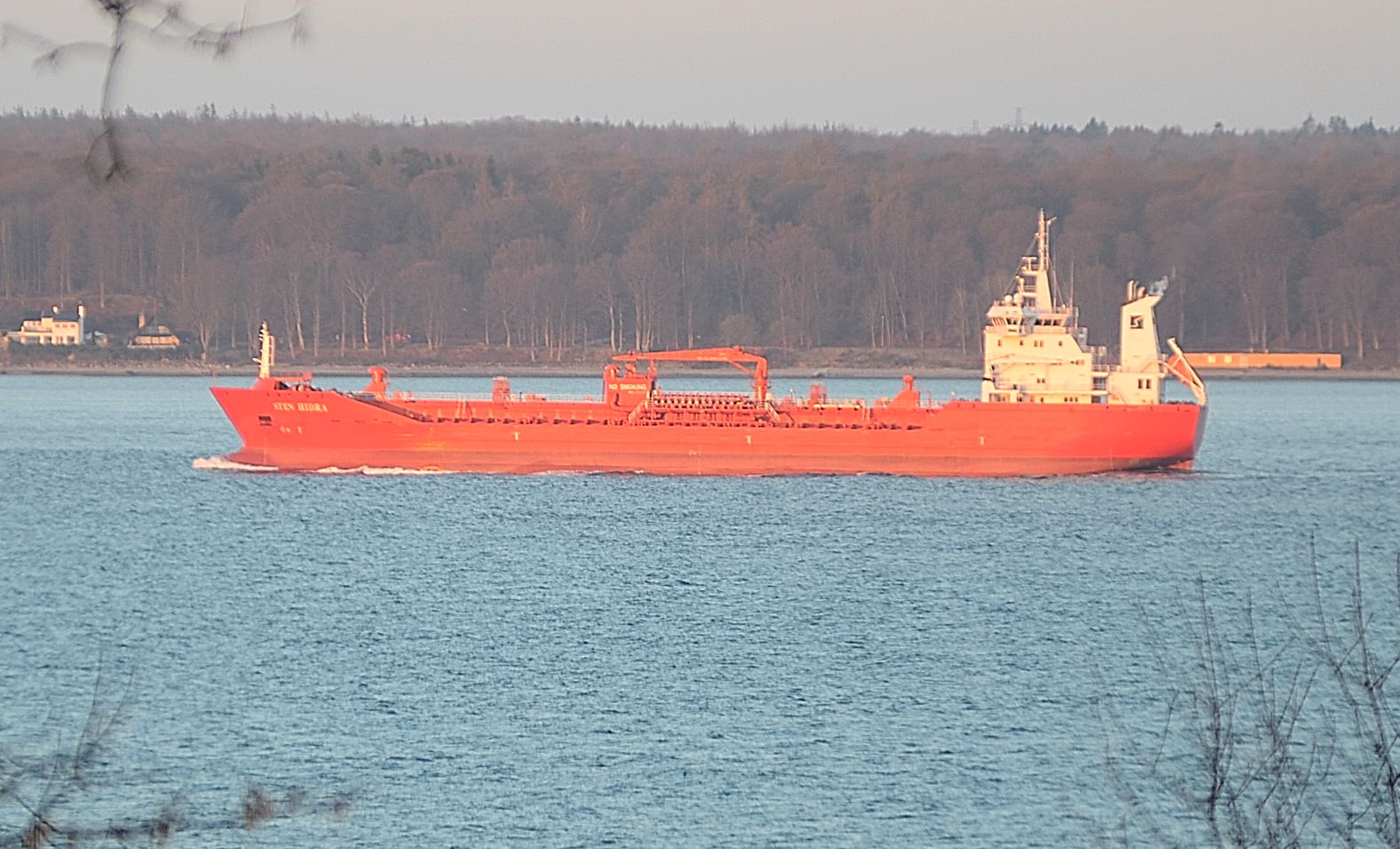
Two Scandinavian tankers meet in Øresund
| Sten Hidra was on its way from Gothenburg to Ventspils. |
| Ras Maersk on its way to Fawley. |
Wednesday, 6 February 2013
An early P&O cruise liner in Stockholm in 1905
![]() |
| S.S. Vectis at Christiania (Oslo), water colour by William Lionel Wyllie (sold by Bonhams) |
Cruising is nowadays an important part of the tourist industry, with hundreds of cruise liners plying the Seven Seas. The first years of the 20th century were still early days for cruises, but both German and British shipowners had already begun to see the vast possibilities pleasure voyages offered to them.
The first ship built exclusively for cruising was the Hamburg-America Line's Prinzessin Victoria Luise, which was completed in 1900.
In 1904 P. & O. refitted its screw steamer Rome as a cruise liner (it had been built in 1881 for the Australian service) and renamed it Vectis. She took passengers on a variety of cruises, including Scandinavia and the Baltic.
The photograph below is from early September 1905, when Vectis visited Stockholm as part of her Baltic cruise.
| The P & O cruise liner Vectis in Stockholm in 1905 |