Showing posts with label St. Petersburg. Show all posts

Tuesday, 6 February 2018

Maxim Gorky and Feodor Chaliapin with friends in 1904


Russian operatic bass singer Feodor Chaliapin (third from the right) talking to writer Maxim Gorky (third from the left) with Skitalets, Andreyev, Chelekov, Chirikov and Bunin

The photograph (here partially coloured by me) was published in the Swedish magazine "Allers Familj-Journal" in 1904. 


Thursday, 11 January 2018

Ladies of Russian aristocratic families making underwear for soldiers in the Russo-Japanese war

The noble ladies in the picture below gathered in St. Petersburg´s Vladimir Palace in order to make underwear for the Russian soldiers fighting in the Russo-Japanese war 1904-1905. The photograph was published in the Swedish magazine Allers Familj-Journal in September 1904. 


Wednesday, 29 January 2014

Noble St. Petersburg ladies sewing underwear for soldiers during the Russo-Japanese war 1904-1905

During the Russo-Japanese War (1904-1905) the ladies of the high nobility gathered in Grand Duke Vladimir's palace in St. Petersburg in order to sew underwear for Russian soldiers. The Vladimir Palace on the Embankment near the Winter Palace was the heart of social life in the Imperial capital at the time:


Monday, 23 December 2013

The Gala Opening of the Mariinsky II on ARTE: Ah, Those Mariinsky Ballerinas!

As part of its Christmas programming, the ARTE television channel last night brought us the opening gala concert of the Mariinsky Theater Second Stage, which took place on 2 May this year.

The concert, which featured such mega stars as Plácido Domingo, Rene Pape and Anna Netrebko, and of course the host Valery Gergiev, was a stunning display of music and dance on the highest level.

However, the ones who made the evening truly memorable, at least for this "reviewer", were the Mariinsky ballerinas. To me, they are the essence and the beauty of the Mariinsky tradition:


Yekaterina Kondarouva

Yekaterina Kondarouva

The Mariinsky Children's Chorus was another of the evening's highlights:


And, of course, Boris Godunov in all his splendour:

Evgeny Nikitin

 
Still another highlight: The Song of the Volga Boatmen
 
Bass Mikhail Petrenko and the Mariinsky Chorus

Tuesday, 26 November 2013

St. Petersburg on Epiphany Day 1905: The Blessing of the Waters Ceremony Takes an Ominous Turn

The ceremonial Blessing of the Waters of the Neva.

The Blessing of the Waters on January 6 (January 19th on the Gregorian calendar), the Feast of Epiphany, was one of the most picturesque ceremonies in Imperial Russia. It took place in a temporary pavilion, erected on the edge of the Neva, right in front of the Winter Palace in St. Petersburg.

On Epiphany Day 1905 the ceremony took an ominous turn:

Tsar Nicholas II, members of the royal family and diplomatic corps attend the ceremonial blessing of the waters of the Neva River in front of the Winter Palace. This is a longstanding tradition celebrating the baptism of Christ in River Jordan transposed to a frigid Russian winter setting. A hole called the Jordan is cut in the ice of the river and the Russian Orthodox Metropolitan of Saint Petersburg immerses his cross in it, blessing and purifying the water. People flock to collect the holy water which is believed to have protective and curative powers.
The Tsar and some of the dignitaries observe the blessing from an elegant pavilion built overlooking the river, while the Tsarina, Grand Duchesses and members of the diplomatic corps watch from the windows of the Winter Palace. The blessing is marked with a military gun salute.

This year, however, the ceremonial gun salute has an unexpected bite. The 17th Battery of the First Horse Artillery of the Guard, one of the most aristocratic of corps in the Russian army, firing from Vasilyevsky Island in response to shots from the Peter and Paul Fortress, has among all the blank saluting cartridges at least one weapon loaded with live ammunition. That gun happens to be aimed right at the Imperial pavilion. A charge of grapeshot peppers the Jordan, injuring one police officer and snapping the flagpole of the Marine standard. The shot also breaks four windows in the Window Palace, where the Tsarina and company stand. Nobody is harmed, but the Tsar’s mother is sprinkled in broken glass.
The official story is that this was negligence, an accident caused when the artillery was not properly cleaned after target practice two days earlier. It’s not a satisfying explanation. The guns can only take a single charge at a time, so how come nobody noticed there was already something in there when they attempted to charge the saluting cartridges on the day of the ceremony? Also, ceremonial salutes aren’t generally aimed right at the Emperor.
On the other hand, any artillery expert would know that grapeshot is not an effective tool of assassination when it has to cross a river to reach its intended target. If one of the soldiers of the battery had been attempting the life of the Tsar, surely he would have loaded the gun with something that had a chance of working. One the lead pellets lands not three feet away from the Tsar, but it’s unlikely it would have harmed him beyond a contusion had it made contact.

Monday, 25 November 2013

The droshkies of Imperial Russia


Writer Ross Browne observed the droshkies on this quay in central St. Petersburg.

On this early 20th century photograph of the Nicholas bridge (the present Blagoveshchensky bridge) and surroundings in St. Petersburg you can see (on the left) a number of traditional open four-wheeled horse-drawn carriages, droshkies, waiting for customers. The American writer
J. Ross Browne, who visited St. Petersburg in 1861, gives this vivid description of  the  droshkies, which once were such a common sight in the former capital of Imperial Russia:

The istrovoschik (sneeze and you have the word)—in plain English, the drosky drivers—are a notable feature in St. Petersburg. When I saw them for the first time on the quay of the Wassaly Ostrow, where the steamer from Stettin lands her passengers, the idea naturally impressed my mind that I had fallen among a brotherhood of Pilgrims or Druids. Nothing could be more unique than the incongruity of their costume and occupation. Every man looked like a priest; his long beard, his grave expression of countenance, his little black hat and flowing blue coat, gathered around the waist by means of a sash, his glazed boots reaching above the knees, his slow and measured motions, and the sublime indifference with which he regarded his customers, were singularly impressive. Even the filth and rustiness which formed the most prominent characteristics of the class contributed to the delusion that they might have sprung from a Druidical source, and gathered their dust of travel on the pilgrimage from remote ages down to the present period. It is really something novel, in the line of hackery, to see those sedate fellows sitting on their little droskys awaiting a customer. The force of competition, however, has of late years committed sad inroads upon their dignity, and now they are getting to be about as enterprising and pertinacious as any of their kindred in other parts of the world. The drosky is in itself a curiosity as a means of locomotion. Like the driver, it is generally dirty and dilapidated; but here the similitude ends; for, while the former is often high, his drosky is always low. The wheels are not bigger than those of an ordinary dog-cart, and the seat is only designed for one person, though on a pinch it can accommodate two. Generally it consists of a plank covered with a cushion, extending lengthwise in the same direction as the horse, so that the rider sits astride of it as if riding on horseback; some, however, have been modernized so as to afford a more convenient seat in the usual way. Night and day these droskys are every where to be seen, sometimes drawn up by the sidewalk, the driver asleep, awaiting a customer, but more frequently rattling full tilt over the pavements (the roughest in the world) with a load, consisting, in nine cases out of ten, of a fat old gentleman in military uniform, a very ugly old lady with a lapdog, or a very dashy young lady glittering with jewels, on her way, perhaps, to the Confiseur’s or somewhere else. But in a city like St. Petersburg, where it is at least two or three miles from one place to another, every body with twenty kopecks in his pocket uses the drosky. It is the most convenient and economical mode of locomotion for all ordinary purposes, hence the number of them is very large. On some of the principal streets it is marvelous how they wind their way at such a rattling pace through the crowd. To a stranger unacquainted with localities, they are a great convenience.


(image by Steve Bartrick Antique Prints)

Another writer, the Rev. Archibald Weir, who visited St. Petersburg a year before Browne, also wrote about the droshkies in the book Vacation Tourists and Notes on Travel in 1860, published by MacMillan and Co. in London:

Droshkies and their drivers, as well as the driving, are worth notice. The former are quite a national institution. From the Tsar to the serf, the droshky is the favourite conveyance. A man may keep any number and any variety of carriages he likes, but the droshky must be one. And no wonder. For one person they are very handy, neat turn-outs ; the horses are generally in good condition ; (a Russian merchant s ambition is to have a fat wife, a fat horse, and a fat coachman) ; the harness is very light, and when, as is often the case, studded over with silver, has a very elegant appearance. Moreover, those ugly appendages, blinkers, are not known in Russia. Droshkies are capable of great speed, and easily managed. Their size suits the build of horses, commonly used, low and short in the draught. One fault only is to be found with them the leg accommodation is scanty. I speak of the modern droshky, in which one sits as in a common chaise. The old-fashioned type, across which one sits astride, has well-nigh disappeared from St. Petersburg. A good many are to be seen at Moscow ; but they are the shabbiest on the streets, and will soon die out there. At St. Petersburg a tariff restrains the extortioning of the isvostchiks. It is true they never take the fare without a grumble ; but the fare is small enough, sevenpence the course. If they take you beyond the range, or with luggage, they make good use of their freedom from rule. But at Moscow things are different There is no tariff there, and consequently one must bargain before one hires, or pay any penalty the driver chooses to levy. There is also a marked difference in the manner of the Moscow isvostchiks. Such abusive, cunning, impudent fellows I never saw. Their eyes twinkle with roguery and insolence. No doubt every one who has ridden in a droshky associates it with insufferable jolting. But the blame is to be laid upon the roads, not upon the carriages. Over a smooth surface, such as the wood pavement in the Nevsky Prospekt, or the beautiful roads at Peterhoff or Tsarskoe-Selo, nothing can be more easy and pleasant than the swift motion of a droshky. But no springs in the world could ever soften the frightful joltings occasioned by the bad roads which mostly prevail. I thought nothing could be worse than the streets of St. Petersburg, till I got to Moscow, where, to the vileness of the pavement is added the hilliness of the ground.

A somewhat later description of the St. Petersburg droshkies is found in the book St. Petersburg (published in 1910) by George Dobson:

The most conspicuous of all the types of street-
life in St. Petersburg is the legkovoi izvostchik*
the Russian cabman, more commonly called simply
izvostchik. He is generally the first to attract the
stranger's attention, for he lies in wait for all new-
comers at every available point, and thrusts the
offer of his services upon them with persevering
insistence. Formerly he and his competitors used
to surround you at railway stations, theatres, etc.,
pull at your coat-sleeves, and argue with you in
the most persuasive manner. This habit of pester-
ing foot passengers at such close quarters is now
seldom indulged in, as the police regulations warn
the izvostchik off the pavements, and compel him to
keep to his seat. The droshky, on which he sits
and waits in every street (there being no regular
cab-ranks), is a small barouche, or victoria, with
more of a pony than a horse in the shafts. In its
present form, with rubber tyres and lifting hood
for rainy weather, it presents a great improvement
on what it was twenty-five years ago, when George
Augustus Sala described it as a perambulator on
four wheels, built for one and a half, and licensed
for two, with a moojick on the box driving like a
London costermonger. But although the droshky
is thus being gradually modernized, thanks to con-
tinual presssure from the police authorities, its
driver, the izvostchik, still remains a peasant from
the country, utterly indifferent to all progress.
More change has taken place in his droshky in the
course of a few years than in the whole race of
izvostchiks for the past century or more. The
political reforms which have bestirred other classes
have left him unmoved, and he seems to be resign-
ing himself to the prospect of being superseded by
electric trams, taxi-cabs, and other self-propelling
vehicles.

Wednesday, 16 October 2013

Thursday, 7 February 2013

Father Gapon - the priest who "bargained with the devil" in revolutionary Russia

Father Gapon, the priest who was prepared to "bargain with the devil", here shown with the Prefect of the St. Petersburg police, general I.A. Fullon. 

The Russian orthodox priest on this photograph Father Gapon, the man who on 22 January 1905 organized the workers' demonstration in St. Petersburg, which transformed into the first act of revolution in Russia. After what later was to be called the "Bloody Sunday", Tsar Nicholas began according to historian Edward Crankshaw "to lose his magic for that mass of simple-minded workers who were not caught up in the revolutionary movement but simply looked to the Tsar for succour". "A monarch cannot allow his personal guards to shoot down in droves in front of his own house an unarmed assembly of working-men, to say nothing of harmless onlookers, and contine to be revered as the source of all wisdom and kindness."

Father Gapon, the instigator of the demonstration, was not blameless either. Most of the demonstrators lacked, according to Crankshaw, "even an inkling of an idea of the inflammatory nature of their plea: they thought they were prostrating themselves before the Tsar and begging him for his protection".

"Gapon, of course, knew what he was doing, but it has never been decided whether he was master or tool. Since he was very shortly, in exile, to show himself megalomaniac to the point of insanity it does not seem to matter very much. The idea that he had become so uplifted by the discovery of his power over large audiences that he believed himself to be the chose one who would, on behalf of the Almighty, open the eyes of the Tsar to his true path is not in itself far-fetched. On the other hand, the duplicity and peasant cunning he displayed when being lionized in Geneva by the émigré revolutionaries suggests that at hear the man was more charlatan than man of God."

(Quotes from "The Shadow of the Winter Palace" by Edward Crankshaw)

After the "Bloody Sunday" the Swedish weekly Hvar 8 Dag sent a correspondent to cover events in Russia in 1905. Below are some of the photographs which illustrated his reports:

 A demonstration in front of the Saint Isaac Cathedral in St. Petersburg a few days befor the "Bloody Sunday".

At the Peter & Paul fortress, where many political prisoners were interned.

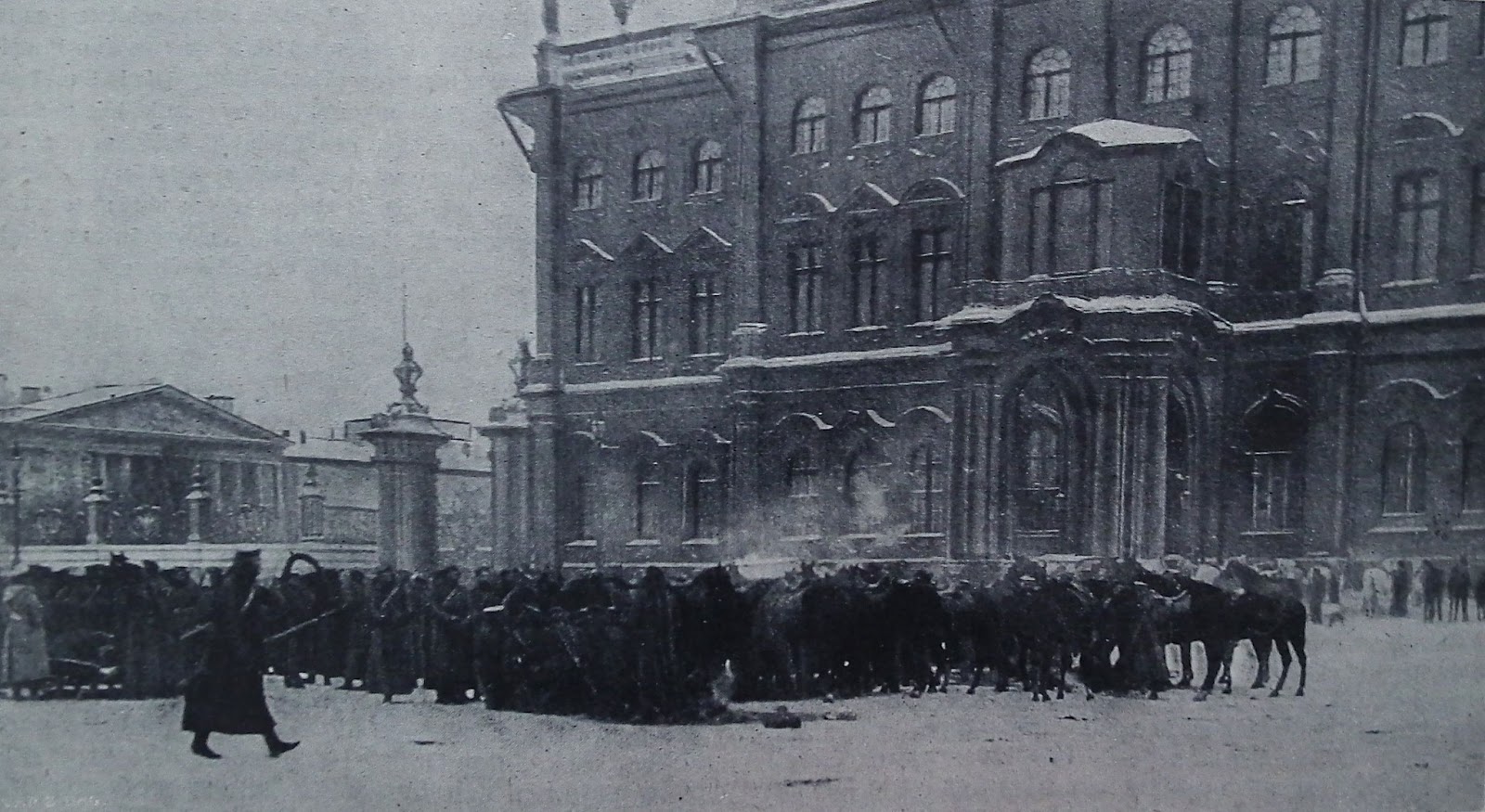
Troops close to the Winter Palace.

Cossacks, which  had arrived in St. Petersburg  before the "Bloody Sunday"

Soldiers guarding the Neva Quay. 

Soldiers guarding the square in front of the Winter Palace.

A bakery shop, which had been robbed during the unrest,  guarded by soldiers.