Showing posts with label films. Show all posts

Sunday, 15 February 2015

Homage to Claudia Cardinale and Lucino Visconti

Homage to Claudia Cardinale and Lucino Visconti:
 
Claudia Cardinale in Lucino Visconti´s "The Leopard"
 
Martin Scorcese once said this about Visconti´s "The Leopard":
 
"One of the films I live by"
 
It is not difficult to agree ...


Saturday, 9 November 2013

"A Celebration of Classic MGM Film Musicals" - An unforgettable evening at the 2009 Proms

Sarah Fox and Sir Thomas Allen at the Prom 22, 2009.
 
 
One of the nice things about the BBC Proms is that they cover such a wide range of music. Late last night for example the BBC HD channel rebroadcast Prom 22, "A Celebration of Classic MGM Film Musicals", one of the absolute highlights of the 2009 Proms.

Soprano Sarah Fox.

Conductor John Wilson and his hand picked orchestra, the Maida Vale Singers and an array of star vocalists, including Kim Criswell, Sarah Fox, Sir Thomas Allen, Curtis Stigers and Seth MacFarlane, made this celebration of the golden age of Hollywood musicals truly unforgettable. John Wilson had painstakingly reconstructed the original orchestral scores, which were lost when the studio destroyed its music library to make way for a car park.

Sir Thomas  Allen.

Sir Thomas Allen and Sarah Fox.


Kim Criswell

For friends of all those great movie classics, including The Wizard of Oz, Meet Me in St Louis, Seven Brides for Seven Brothers, High Society, Gigi and Singin' in the Rain, this stunning evening of great film music is fortunately available also on DVD.     

Thursday, 29 November 2012

"Jascha Haifetz: God's fiddler" - a great documentary

   "God's Fiddler"

As years go by, I have noticed that I spend less and less time watching television. However, good documentaries, especially about art and classical music are still one great reason to turn on the telly. 

The other night German WDR showed one of the best documentaries I have seen in years - Peter Rosen's "Jascha Haifetz: God's fiddler". I wholly agree with what this commentator wrote about the film:

"I had the opportunity to see this beautiful documentary film about Mr. Heifetz. Throughout the film, there are many chances to hear his great violin artistry. Great clips from his own home movies with family and friends are shown for the first time. This film will provide a great introduction to a generation that only knows his name and a first time look into his private world for many of those who have heard him play in person. Ayke Agus contributes heartfelt opinions and insight into the man that she worked with for his last 15 years.(Look for her marvelous book "Heifetz as I knew him".)"


Ayke Agus on Heifetz: "Maybe he did not know who he was either, except when he was holding his violin"

Of the many knowledgeable and interesting musicians - among them Izak Perlman, Ivry Gitlis, Ida Haendel  and Nathaniel Rosen - interviewed, I think pianist Ayke Agus stands out. To hear her talk about Heifetz is both fascinating and highly rewarding. 

If you have not seen Rosen's marvelous film, I urge you to buy it. You will not be disappointed. 

Below is the film trailer:


(If the video does not play, choose the "watch on YouTube" alternative mode.)

Thursday, 1 November 2012

Nino Rota - the great maestro of film music

"When I’m creating at the piano, I tend to feel happy; but - the eternal dilemma - how can we be happy amid the unhappiness of others? I'd do everything I could to give everyone a moment of happiness. That's what's at the heart of my music."
Nino Rota

If I would be asked to name the best ever composer of film music, I would not hesitate to choose Nino Rota (1911 - 1979), the great Italian maestro of film scores. Rota was not only a prolific film composer - the list of his film scores includes at least 173 films - but above all the musical quality of his scores was - and still is - astounding. In addition to the film music, Rota found the time to compose a lot of "ordinary" music, e.g. ten operas, five ballets and a countless number of works for orchestra.


The list of directors Rota co-operated with during his long career includes many of the greatest directors of his time, most of them of Italian, but also many others. Here are just a few of them: Federico Fellini, Luchino Visconti, Vittorio de Sica, Franco Zeffirelli, Francis Ford Coppola, King Vidor, Sergei BondarchukLina Wertmüller, Jan Troell.

Here a five of my personal Rota favorites:


Monday, 16 July 2012

Wednesday, 23 May 2012

Kristin Scott Thomas - A Great Actress

Kristin Scott Thomas about her role in Claudel´s film: 'I loved it. No make-up; I hardly even speak.'

There are many outstanding English actresses, but one of my own absolute favourites is Kristin Scott Thomas, who is perhaps mostly remembered for her fine role portraits in such films as "A Handful of Dust", "Four Weddings and a Funeral" and "The English Patient". But - in my opinion - it is in Philippe Claudel´s "I´ve Loved You So Long" where Scott Thomas´s amazing acting really shines.

In Claudel´s deeply moving tale of two sisters rebuilding their relationship, Scott Thomas gives an unforgettable portrait of the elder sister,who returns after serving a 15 year prison sentence. Elsa Zylberstein is also oustanding as the younger sister.

Elsa Zylberstein as the younger sister
The two sisters in Claudel´s memorable film


In an age so obsessed with youth, Kristin Scott Thomas´s way of describing (2008) her own aging is a relief:


'Now I can be the mother I want to be, the woman I want to be, the actress I want to be. I am afraid that all this has happened to me with getting older. I'm 47 - unlike most actresses, I don't lie about my age - but I'm liking this bit. I love it. I wouldn't swap it for a million years.'

Saturday, 10 March 2012

The real artists - Silent film stars of the 1920´s

Silent films are probably not going to make a major comeback, inspite of the several Oscars awarded to "The Artist". However, a certain interest in the film industry of the 1920´s is in the air. As my own modest contribution, here are a few pictures of some of the big silent film stars of that era:

Lucy Doraine
Ramón Novarro and Alice Terry

Douglas MacLean and Marguerite de la Motte

Greta Garbo was called "the most beautiful Swedish actress" already in 1925
Norma Talmadge
Leatrice Joy

John Gilbert and Norma Shearer


Thursday, 1 March 2012

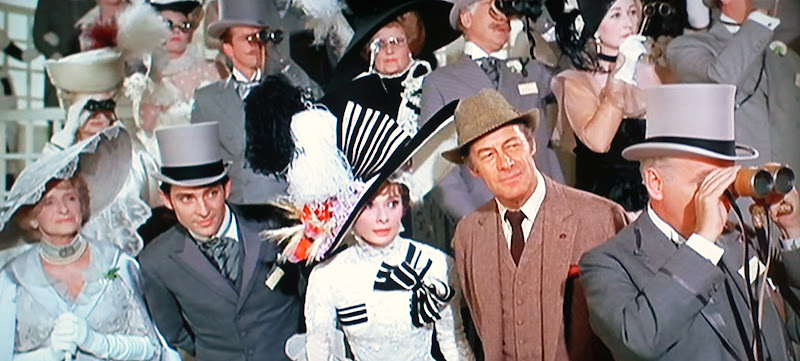
The splendor of My Fair Lady

The wonderful Audrey Hepburn as Eliza Doolittle

There are many outstanding film versions of great musicals, but none of them - except perhaps The Sound of Music - comes close to George Cukor´s My Fair Lady from 1964.

No wonder that the film garnered twelve Oscar nominations and was awarded with eight statuettes, including Best Picture, Best Actor (Rex Harrison), Best Director (George Cukor), Best Art Decoration, Best Sound, Best Costume Design, Best scoring, and Best color Cinematography.

Audrey Hepburn was for some reason not nominated in the Best Actress cathegory - although she should have been.

However, I agree with one reviewer, who wrote that "the major star of the film is perhaps set designer/costume designer Cecil Beaton, whose visual contributions immediately impacted European and U.S. fashion trends."

I hope these pictures give you an idea of the quality Beaton´s creations - and the eternal beauty of the wonderful Audrey Hepburn:


PS

My Fair Lady is now also availabe on blu-ray - another reason to buy the disc if you do not already own it.


Monday, 27 February 2012

James Bond´s favourite champagne


As all friends of James Bond know, OO7 had - or should we say still has - an exquisite taste for good wine and other related beveridges. Already in the first movie, Dr No, Bond shows his preference for champagne; Dom Pérignon.


When asked by Dr No to taste the champagne, a Dome Pérignon 1955, Bond - after first thinking about using the bottle as a weapon - replies that he prefers the 1953 vintage.

Who was right about the vintage, Dr No or Bond?

Dom Pérignon’s Chef de Cave, Richard Geoffroy should be the right person to judge. Here are his comments about the vintages:


1953 Dom Pérignon

1953 was a generous vintage, very expressive right at release (about as totally opposed to 1952 as possible). Rich and full, mellow and luscious, this wine reveals notes of butter, honey and dried apricot. As the wine breathes the toasted character stands out to evolve in the end towards iodine and oyster shells.

1955 Dom Pérignon

1955 was the archetype of the classical vintage that defines harmony in Champagne—maybe the greatest of the decade. Very energetic and racy, remarkably thorough, this wine is at the same time intense and profound. These qualities express the typical, intriguing paradox of youth versus maturity, combining to create a feeling of completeness. Right in the center, the fruit (sultana) is still very vibrant, with notes of vanilla, smoke and praline (sugar-coated almond).

Well, according to the expert, both the 1953 and the 1955 seem to have been excellent vintages. So Dr No, in spite of being a bad crook, at least seems to have known how to appreciate good quality champagne.

Later Dom Pérignon reappeared in at least these Bond movies:

Goldfinger (vintage 53)

The Spy Who Loved Me (52)

On Her Majesty´s Secret Service (57)

You Only Live Twice (59)

Thunderball (55)

The Man with ghe Golden Gun (64)
(Although Bond says he prefers 62)


In several of the latest Bond movies 007 seems to have switched to Bollinger - another superb champagne classic - but at least this friend of Bond´s prefers his original choice of brand.

Friday, 17 February 2012

The 1979 production of Tinker, Tailor, Soldier, Spy is great on dvd

The grainy picture adds to the authenticity

I have recently praised several blu-ray editions of classic films and television series. The blu-ray technology in most cases enormously enhances both the visual and the audio enjoyment. However, there is at least one television series, the 1979 BBC version of John le Carrés Tinker, Tailor, Soldier, Spy, in which the old dvd format, with its grainy picture, actually adds to the impression of authenticity.

Sir Alec Guinness as George Smiley

There is a new movie version of le Carrés novel, which is said to be good too, but it is difficult to imagine that it could beat the "original" with Sir Alec Guiness in the main role as George Smiley.
Also the other actors are outstanding, as is the music and camera work. This was British television at its best!

Sunday, 22 January 2012

The story of the Disco Volante, Mr. Largo´s ship in the fourth Bond movie


The Disco Volante in the Caribbean night


Thunderball, the fourth James Bond film starring Sean Connery was a huge success already in its opening year 1965 and is, to date, the most financially succesful movie in the series. (Adjusting for inflation the movie had made $966.4 million in 2008 currency).

Mr. Largo´s ship Disco Volante plays an important role in Thunderball. A recent viewing of the beautifully restored blu-ray version of the movie, made me curious about the ship´s story.

Thanks to Wikipedia it did not take more than a few seconds to find out:

The real craft used in the film was a hydrofoil ferry, The Flying Fish, built by Rodriquez Cantieri Navali, who had built the first successful one at Freccia del Sole. The "cocoon" was built on set. It was purchased for the film for $500,000 and brought from Puerto Rico to Miami for refitting and refurbishment. The hydrofoil never sailed again after the filming. It was rented as a stationary houseboat, docked at a marina on Miami's MacArthur Causeway, until it sank at the dock in the early 1980s.

A sad end to the Disco Volante, both in the movie and in real life.

The Disco Volante was able to reach a decent speed even with the "cocoon"

Here Mr. Largo gets rid of the $500,000 "cocoon"
This is the real hydrofoil in good speed somewhere in the Bahamas

This is the moment when Bond and his lady partner jump into the water before the ship hits the rocks


Wednesday, 18 January 2012

The Red Shoes - A visual and musical masterpiece

Vicky Page (Moira Shearer), a young ballerina, torn between her love for composer Julan Crasher (Marius Goring) and artistic devotion to ballet dancing.


In several earlier blogs I have praised blu-ray versions of classical movies. Having watched the wonderfully restored "special restoration edition" of Michael Powell´s and Emeric Pressburger´s "The Red Shoes" I have reason to do it again.

Vicky Page here with the famous impresario Lermontov (Anton Walbrook)

This special edition is a visual and musical delight with its stunning technicolor colour, wonderful acting and dancing and great directing by Powell and Pressburger. It is easy to agree with director Martin Scorcese, whos had this to say about the film:

"Michael Powell and Emeric Pressburger created a vision in The Red Shoes that has really never been matched. Truly the most beautiful technicolor film ever made."

The Red Shoes also offers beautiful Mediterranean panoramas ...
and this nice view of the Palais Garner, the Paris Opera House in 1948
Vicky Page and the composer Julian Craster discussing their future 

Moira Shearer shines both as a dancer and an actor


PS
Buy this wonderful special edition blu-ray! You will not regret it, even if you are not particularly interested in ballet.

Friday, 16 December 2011

The Sound of Music shines on blu-ray


Today I received my copy of the blu-ray version of one of my absolute favourite musical movies, The Sound of Music. What a visual and musical delight the new blu-ray disc is! If you enjoy the movie, it is well worth investing a few dollars in this wonderful disc. One never gets tired of watching and listening to Julie Andrews! And Cristopher Plummer and all the others are excellent, too.


Monday, 5 September 2011

I was James Bond´s neighbour - almost

There have been many James Bonds, but for me there is only one:


This is my personal favourite Bond music:


PS

As a matter of fact, I have a tiny personal "connection" to Bond. According to Ian Fleming, Bond´s flat was on a little plain-tree´d square off of King´s Road in the Chelsea area of London. John Pearson has placed the flat at 30 Wellington Square.

In the late 80´s and early 90´s I had the privilege to live in one of the Wellington Square Regency terraces, built by Francis Edward in 1830-1832, although it was not number 30. At the time I did not know about the Bond connection. Maybe my neighbour, the German assistant military attaché was then the closest to Bond´s world - if one does not count former Chancellor of the Exchequer, Norman Lamont (Now Baron Lamont of Lerwick) who also lived in one of the houses for some time.

For all James Bond fans - and others as well - a visit to this, the most beautiful of all Chelsea squares is highly recommended!

Wellington Square 30 was the literary home of James Bond

Wednesday, 26 January 2011

La Vie En Rose - a film not to be missed


Edith Piaf is probably not a very wellknown name to young people. But for many of us, who have been around a little longer, her songs are unforgettable. Piaf - like so many other stars - had a difficult life, with more than enough of trouble and hardships. The story of Piaf´s tragic life is the subject of the talented French director Olivier Dahan´s film "La Vien En Rose". If you have not seen the film yet, I urge you to see it. Below are a couple of links with a great number of wonderful reviews, so I will only say that Marion Cotillard in the title role is truly amazing. No wonder she won an Oscar for the role. One of the best new films that I have seen in many years!

La Vie on Rose on IMDb and Amazon.

Here you can watch the film trailer. (The film fortunately uses the voice of the real Piaf in the songs).

Saturday, 22 January 2011

Simple pleasures nr 10: HD television


If you are about my age - which means not extremely young anymore - you will remember the first television broadcasts; the entire family gathered every evening in front of the miniscule telly in order to watch the favourite black and white programmes. Now - in  my case - over half a century later, we have enormous flat screens with High Definition quality picture and sound. A change to the better, which we, at least in my opinion, have to be grateful for.

Nowadays I watch mostly German language HD channels. The two main channels Erste and ZDF are technically of a very high quality, but they seldom show anything of great interest to myself - although they sometimes (particularly at Christmas time) surprise by broadcasting great concerts of classical music, opera and documentaries. My favourite HD channel is the German-French ARTE, which offers a great selection of high quality arts programmes and documentaries. Thanks to the HD technique, the picture quality is amazing. It is particularly fascinating to watch concert broadcasts and nature programmes.

Another German language HD channel is Austrian Servus TV, which in my opinion has the best HD picture quality of them all, although not all of their programmes are interesting from my point of view.

Then there is the additional bonus, that even the old dvd:s look great on HD equipment. The old classic "An American in Paris" looked like a new film, when I watched it on my HD blueray player the other day.

So, I say thank you to all of you out there somewhere, who have worked hard in order to give us the possibility to enjoy high quality HD television!

Sunday, 16 January 2011

Rififi - a film noir masterpiece


The other day I rewatched Jules Dassin´s Film Noir masterpiece "Rififi" (1955), which now is available on dvd with fully restored picture and sound. And what a great movie it is! No wonder François Truffaut called it "The best Film Noir I´ve ever seen".

Here is a brief summary of Rififi (by one of IMD:s contributors), in case you have not seen the film:

After five years in prison, Tony le Stéphanois meets his dearest friends Jo and the Italian Mario Ferrati and they invite Tony to steal a couple of jewels from the show-window of the famous jewelry Mappin & Webb Ltd, but he declines. Tony finds his former girlfriend Mado, who became the lover of the gangster owner of the night-club L' Âge d' Or Louis Grutter, and he humiliates her, beating on her back and taking her jewels. Then he calls Jo and Mario and proposes a burglary of the safe of the jewelry. They invite the Italian specialist in safes and elegant wolf Cesar to join their team and they plot a perfect heist. They are successful in their plan, but the D. Juan Cesar makes things go wrong when he gives a valuable ring to his mistress.

The famous safe-cracking sequence, without spoken words or music, that occupies a fourth of the film´s running time shows Dassin´s greatness as a film director. It has been said that the Paris police briefly banned the movie, because they feared that it could be used as an instruction manual by real criminals. But Dassin does not in any way glamorize robbery or the criminals - on the contrary.

The great Jean Servais is outstanding as Tony le Stéphanois, and the other actors also are top class. Buy the dvd if you want an unforgettable film evening!

Here you can watch the wellknown song sequence in "Rififi":

Monday, 3 January 2011

The beauty of old film locations

The other day I rewatched the classic Hollywood love story "Love Is A Many-Splendored Thing"  (1955) with William Holden and Jennifer Jones in the main roles. The film shot on location in Hongkong  was still as romantic as I thought it would be, and I thoroghly enjoyed it. But what particularly caught my attention were the beautiful sceneries from Honkong of the 50´s. What a beautiful place it was! (My own two visits to HK took place in the early 80´s, and as far as I can remember, the locations looked pretty much the same then. How HK looks now, I do not know, but hopefully much of the old charm is still there).

When I think of it, probably one important reason why it is so nice to watch old films, is that you get to see how some of your favourite places looked like long ago. Just a couple of examples: The post war Vienna in "The Third Man", Paris in "An American in Paris" or "Gigi", Rome in "Three Coins in the Fountain", San Francisco in "Vertigo", Los Angeles in "Chinatown", Hawaii in "From Here to Eternity"  and Venice in David Lean´s "Summertime". The list is endless. Sometimes even otherwise boring films can be interesting because of the locations.

For those interested in more information about movie locations there is an excellent resource: The World Wide Guide to Movie Locations.

PS
If you want to get a glimpse of Honkong as it was shown in "Love is a Many-Splendored Thing", watch this - and listen to one of the most beautiful film melodies ever, or this:


Wednesday, 29 December 2010

My "Oscar" for lifetime achievement goes to Clint Eastwood


Every movie I make teaches me something, and that's why I keep making them. I'm at that stage of life when I could probably stop and just hit golf balls. But in filming these two movies about Iwo Jima, I learnt about war and about character. I also learnt a lot about myself.
Clint Eastwood

Clint Eastwood (born 31 May 1930) is one of my greatest living film heroes. His over 50 year long involvement with films is unrivalled, with a multitude of roles, covering everything from early action movies - like Dirty Harry - to the under-appreciated boxing trainer in the Million Dollar Baby. And additionally Eastwood is a member of the very exclusive "club" of actors who also have managed to be succesful film directors. He has directed over 30 films.(Among my personal favorites are Eastwood´s two Iwo Jima films, Flags of Our Fathers and Letters from Iwo Jima.)

Watch Eastwood as Harry Callahan in this famous scene:


The Telegraph did an interesting interview earlier this year, when Eastwood turned 80.