Catastrophes, wars, terrorism, ecological disasters, deadly diseases, poverty .... The list of tragedies - both personal and public - is endless. Every day and hour media, politicians, experts - and charlatans - bring us a never ending barrage of bad things. No wonder that many people feel depressed and weary. This blog tries - in a modest and personal way - to contribute to a more balanced view. After all, there is so much to appreciate and enjoy in life ...
Showing posts with label Stockholm. Show all posts
Thursday, 24 March 2016
The Swedish painter Georg Pauli´s 50th anniversary party in 1905
On July 2 in 1905 the Swedish painter Georg Pauli celebrated his 50th birthday at his new summer residence in the Stockholm archipelago. The guests were mostly leading representatives of the Swedish and Scandinavian cultural elite:
Nr 1 is His Royal Highness, Prince Eugen, an eminent painter himself; nr 2 is Pauli´s wife Hanna, a leading painter herself; nr 3 is Georg Pauli; nr 4 is the writer Ellen Key: nr 5 is the painter Richard Bergh; nr. 11 is the publisher K.O. Bonnier and nr 12 is the Danish painter Viggo Johanssen.
The black and white photograph was published in the Swedish weekly Hvar 8 Dag in July 1905.
(Colouring and processing by me.)
Labels:
1905,
archipelago,
artist,
old photograph,
painter,
People,
Stockholm,
Sweden
Wednesday, 11 December 2013
The Nobel Banquet - A Spectacular Culinary Achievement
![]() |
| The entrance of the altogether 260 waiters serving the over 1300 guests is always a spectacular sight. |
December 10 is always the day for the great Nobel Banquet, which takes place in the Stockholm City Hall after the Nobel Prize Award Ceremony. As the Nobel prizes are regarded as the most prestigious prizes in the world, also the Banquets have become major international events.
![]() |
| Chef Andreas Hedlund interviewed on Swedish television last night. Hedlund was in charge of the menu also last year. |
Last night's Nobel Banquet was again a spectacular culinary achievement. The man in charge of the "army" of 43 cooks (!) was Andreas Hedlund (2002 Swedish Chef of the Year) along with Fredrik Björlin (former captain of the Swedish Culinary Team) as well as Pastry Chefs Conrad Tyrsén (2009 Swedish Pastry Chef of the Year) and Ted Johansson of Dessert&Choklad Stockholm.
![]() |
| The Guinea hen mosaic starter. |
The menu last night:
Guinea hen mosaic, carrot variation with Gotland truffle and chanterelle duxelle with truffle mayonnaise
Turbot cupola stuffed with Norwegian lobster, tartelette with lobster on a bed of cream cheese and spinach, pointed cabbage terrine, lobster sauce and almond potato purée
Chocolate silhouette with nougat and sea buckthorn explosion
The wines:
Champagne Gaston Chiquet Cuvée Tradition
Brut Premier Cru
Château l’Hospitalet La Reserve Rouge 2011
Coteaux du Languedoc la Clape
Nivole Moscato d’Asti 2012
Michele Chiarlo
Labels:
food,
Nobel Prize,
Stockholm,
Sweden
Sunday, 10 November 2013
Mozart's La Clemenza di Tito at the Drottningholm Palace Theatre 2013 - A musically and visually superb performance
![]() |
| The cast of the Drottningholm Palace Theatre performance of Mozart's La Clemenza di Tito. |
Thank God that you can still find non-modernized performances of classic - particularly baroque - operas! One of the best - and certainly the most beautiful - venues for historically informed performances (HIP) is the Drottningholm Palace Theatre in Stockholm.
This intact 18th century opera theatre, which has been described as "the Swedish jewel in our European cultural heritage crown of centuries-old theatres", was after the assassination of King Gustav III in 1792 (Verdi based his Un ballo in maschera on the event) forgotten for almost 130 years, until it was rediscovered in 1921.
The highlight of the Drottningholm Palace Theatre's 2013 summer season was without doubt Mozart's La clemenza di Tito in a HIP production by Sigrid T'Hooft. Last night, those who did not have a chance to attend one of the performances, could watch Swedish SVT2 channel's broadcast of the opera. The star studded cast included Richard Croft (Tito), Katija Dragojevic (Sesto), Annemarie Kremer (Vitellia), Luciana Mancini (Annio), Elena Galitskaya (Servilia) and Markus Schwartz (Publio). The The Drottningholm Theatre Orchestra was eminently conducted by Drottningholm's artistic director Mark Tatlow. The small, but superbly singing chorus consisted of members of the Swedish Radio Choir.
One must hope that this performance of extraordinary musical and visual beauty soon will be available on DVD!
![]() |
| Mezzo soprano Luciana Mancini as Annio was one of the brightest stars of the evening. |
![]() |
| Tenor Mark Croft was a superb Tito. |
![]() |
| A scene with Tito, Publio and Sesto. |
![]() |
| Sesto, Publio and Vitellia. |
![]() |
| Members of the excellent Drottningholm orchestra. |
Monday, 15 April 2013
George and Hanna Pauli - a celebrated Swedish artist couple in the early 1900s
| George and Hanna Pauli on July 2, 1905. |
The home of Swedish painters George Pauli (1855 - 1935 and Hanna Hirsch-Pauli (1864 - 1940), who married in 1887, was a very popular gathering place for Stockholm's cultural elite in the early 1900s. On 2 July 1905, the couple invited their closest friends to their summer house in the Stockholm archipelago in order to celebrate Georg Pauli's 50th birthday.
| George and Hanna Pauli with friends on July 2, 1905 in the Stockholm archipelago. |
![]() |
| "A French confirmand" by George Pauli (image wikipedia) |
Hanna Pauli, who later came to overshadow her husband as a painter, is above all remembered for her exquisite portraits.
| Hanna Pauli's famous 1887 portrait of her artist friend, Finnish painter Venny Soldan. The portrait is now on display at the Gothenburg art museum. |
Saturday, 2 March 2013
Nordenskiöld's return to Stockholm in April 1880
| The Vega in front of the Royal Palace in Stockholm in April 1880. |
The Finnish-born scientist and explorer Adolf Erik Nordenskiöld, who lived in exile in Sweden after 1857, made his most famous journey through the Northeast Passage between the years 1878 and 1979.
Nordenskiöld started his journey from Karlskrona on June 22, 1878 aboard the steamship Vega, a 43 meters long whaling ship, which had a 60 horse-power steam engine. The crew consisted of 21 men. In addition there were a number of scientists and officers. Swedish naval lieutenant Louis Palander was commander on the Vega.
| The Vega crew. |
On September 2, 1879, Nordenskiöld reached reached Yokohama in Japan, and was celebrated as a hero all over the world. Although the voyage did not open the Northeast Passage through the Bering Strait for commercial traffic, it attracted people's imagination. This was the time when Jules Verne had published his book Voyages Extraordinaires and Stanley had found Livingstone in the African jungle.
![]() |
| The famous painting of A.E. Nordenskiöld by Georg von Rosen. |
On April 24,1880, Vega finally arrived in Stockholm. Nordenskiöld was duly feted, and King Oscar II, the financier of the voyage, made him a baron.
![]() |
| The return of the Vega in Stockholm on April 24 was a spectacular event. (image by wiki) |
After Nordenskiöld's death in 1901, the collection was according to his wish returned to his old home country Finland. Since 1902 it belongs to the University of Helsinki Library.
Labels:
exploration,
Finland,
North East Passage,
Stockholm,
Sweden
Sunday, 17 February 2013
An imperial visit: Czar Nicholas II in Stockholm in 1909
King Gustaf V and Queen Victoria took the Royal barge Vasaorden to the Imperial yacht Standart in order to greet the guests:
| Csar Nicholas and empress Alexandra arrive together with their Swedish hosts on board the Vasaorden for the official welcoming ceremony. |
| Moments later. Large crowds of people had gathered in front of the Grand Hotel in order to watch the arrival ceremony. |
| The imperial guests are introduced to the receiving dignitaries. |
| Czar Nicholas and empress Alexandra at the decorative pavilion erected for the welcoming ceremony. |
| Czar Nicholas and King Gustaf on their way to the Royal palace. |
The Imperial yacht Standart in Stockholm.
PS
The official state visit was marred by the assassination of Major General Beckman, Chief of Sweden's Coast Artillery. General Beckman was shot twice outside of the Grand Hotel by an assassin who then killed himself. King Gustaf V hosted a state banquet for the visiting Csar at the royal palace that evening.
|
Wednesday, 6 February 2013
An early P&O cruise liner in Stockholm in 1905
![]() |
| S.S. Vectis at Christiania (Oslo), water colour by William Lionel Wyllie (sold by Bonhams) |
Cruising is nowadays an important part of the tourist industry, with hundreds of cruise liners plying the Seven Seas. The first years of the 20th century were still early days for cruises, but both German and British shipowners had already begun to see the vast possibilities pleasure voyages offered to them.
The first ship built exclusively for cruising was the Hamburg-America Line's Prinzessin Victoria Luise, which was completed in 1900.
In 1904 P. & O. refitted its screw steamer Rome as a cruise liner (it had been built in 1881 for the Australian service) and renamed it Vectis. She took passengers on a variety of cruises, including Scandinavia and the Baltic.
The photograph below is from early September 1905, when Vectis visited Stockholm as part of her Baltic cruise.
| The P & O cruise liner Vectis in Stockholm in 1905 |
Wednesday, 16 January 2013
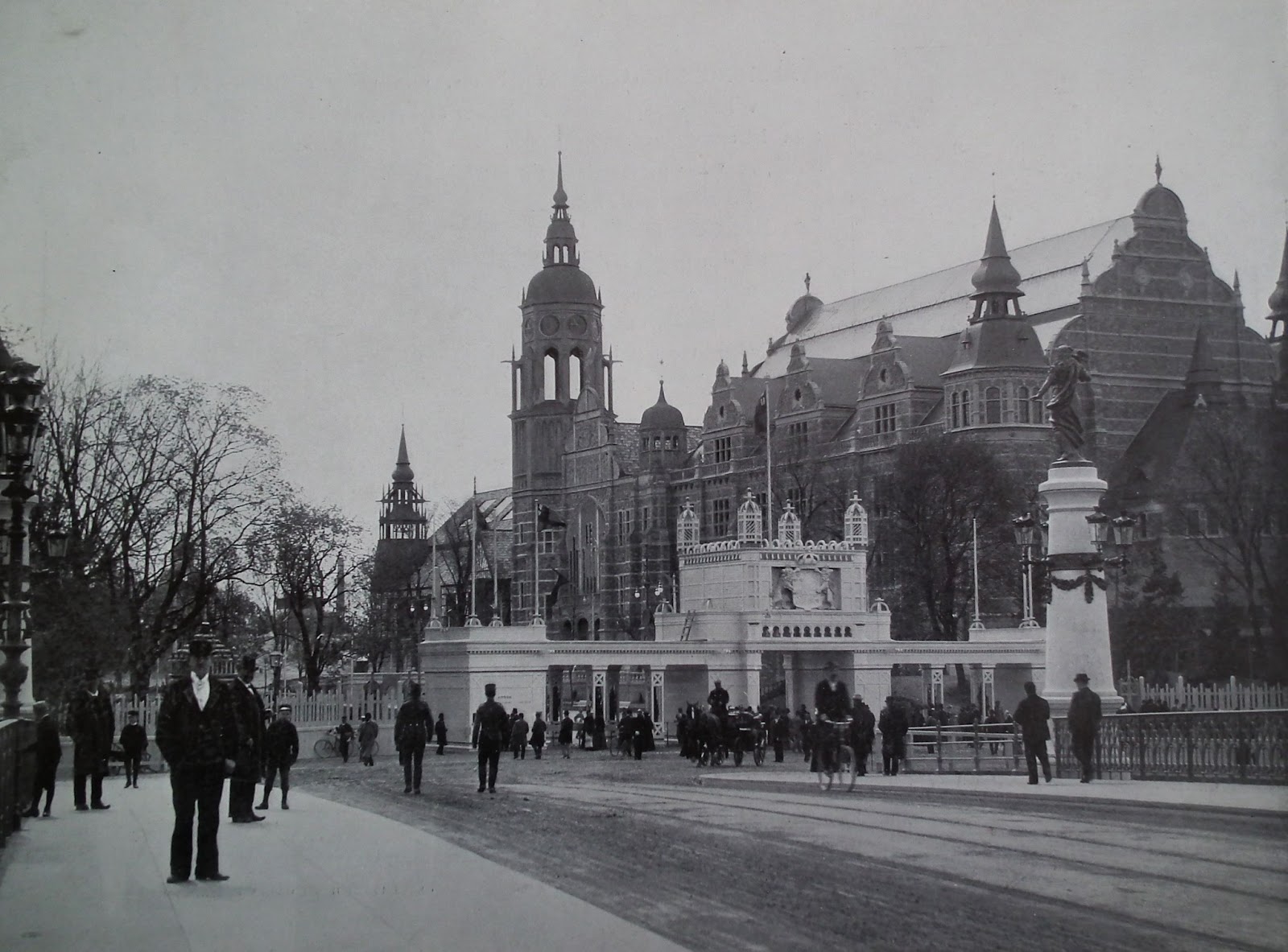
The 1897 Stockholm General Art and Industrial Exposition
![]() |
| A general view of the exposition area. (image by wikipedia) |
The 1897 Stockholm General Art and Industrial Exposition was a huge undertaking, and also a major international media event. When the exhibition closed on October 3, having been open since May 15, there had been a staggering 1,5 million visitors.
The 1897 exposition was the fourth and largest in a series of Scandinavian fairs. This time also Finland and Russia took part. (In order to make the Finnish participation possible, also Russia, of which Finland at the time was an autonomous Grand Duchy, had to be invited).
Formally the exposition was organized in order to mark the 25th anniversary of King Oscar II's regency. Altogether 3 722 exhibitors took part, displaying a multitude of objects in the 208,000 square meter exposition area in the southern part of Djurgården. Many new technical inventions, like moving pictures and the modern bicycle, were introduced at the fair.
| The exposition area, seen from Strandvägen. The bridge connecting Djurgården with central Stockholm was built for the exhibition. |
| The Swedish-Danish "fish hall" (center, left) and "Old Stockholm" were popular among visitors. The huge candle on the right was erected by the Liljeholmen candle manufacturing company. |
| The 50 meter high industry hall, with four "minarets", designed by the F. Boberg (the architect in charge of the exposition), was considered to be the grandest of all the about 100 pavilions. |
| The forest exhibition hall, also designed by Boberg. |
| The city of Stockholm's pavilion and the main restaurant building. |
| The "engine hall" on the left and the pavilions of the Royal Swedish armed forces. |
| The white art pavilion, designed by Boberg, was considered to be the most beautiful of all the exposition buildings. The statue in front of the pavilion portrays Swedish king Carl X Gustaf. |
| Part of the "Old Stockholm" area, showing how the city looked 300 years earlier. |
Wednesday, 21 November 2012
A portrait of a young man by Botticelli in the Royal Palace in Stockholm
Saturday, 10 November 2012
The centenary of the Stockholm Olympics 1912
With the spectacular London Olympics fresh in our memory, I thought it might be of interest to take a look what happened at the Summer Olympic games in Stockholm, a hundred years ago.
Wikipedia gives us the basic facts:
The 1912 Summer Olympics, officially known as the Games of the V Olympiad, were an international multi-sport event held inStockholm, Sweden, between 5 May and 27 July 1912. Twenty-eight nations and 2,408 competitors, including 48 women, competed in 102 events in 14 sports. With the exception of tennis (starting on 5 May) and football and shooting (both starting on 29 June), the games were held within a month with an official opening on 6 July. It was the last Olympics to issue solid gold medals and, withJapan's debut, the first time an Asian nation participated. Stockholm was the only bid for the games, and was selected in 1909.
The opening ceremony on 6 July was of course a huge event in Sweden at the time:
| The "confident Americans" at the opening ceremony. |
| The "jaunty Danes". |
| In 1912 Finland was still an autonomous Grand Duchy of Imperial Russia, but was allowed to send a team to the Stockholm olympics. |
| A Swedish sport writer wrote about the this French "outdoor" tennis player: Mlle Broquedis won the sympathies of the audience because her playing was both skillful and gracious." |
| Neither is long jump from a standing position anymore an Olympic discipline. This picture shows the start position of the Stockholm gold medal winner, Mr. Tsiclitiras from Greece. |
| The winner of the high jump competition, Mr. Richards from the U.S.A. |
| The Swedish pole jumper B. Uggla won a bronze medal with this jump (3,8 m). |
| The American R.W. Rose won the gold medal in shot put with to arms. |
| The British gold medal team in 400 swimming for ladies. |
| The winner of the 100 m free style swim competition, American Duke Kahanamoku was looking cool already 100 yars ago. |
| The Finn Kolehmainen, who won both the 5000 and 10000 m competitions, became a great hero in his homeland. |
| These two well dressed gentlemen - King Gustav of Sweden and the Crown Prince - are on their way to the prize ceremony. |
| This proud Finnish football (soccer) team beat Italy - after 2 x 15 min. extra time - with 3-2. That was probably the first and only time Finland has beaten Italy in football! |
| Norway's Magda, the winner of the 12 m class in sailing. |
Subscribe to:
Posts (Atom)