Showing posts with label World War 1. Show all posts

Saturday, 22 September 2012

The Swedish merchant fleet during World War 1

Some Swedish merchant ships were marked with a flag showing the Swedish colours

Neutral Sweden was not a participating nation in the World War 1, but still the country was in many ways affected by the war. Particularly, the Swedish merchant fleet was hit quite hard; during the war years it lost altogether 194 ships, 17% of its total tonnage. 


1918 map of submarine blockade zones
Almost all Swedish ship losses happened in the submarine zone (the German U-boat blockade zone) around the British Isles (mainly in the North Sea and the English Channel). No ship losses were recorded in the Baltic


Map of mine fields and other mined and dangerous areas in the Baltic
(published by Reichs Marine Amt, 1919)

Of the 194 ship losses 124 were caused by submarines, whereas 36 ships were lost because of mines. Altogether 437 Swedish sailors lost their life due to the war. 
German, Danish and Swedish mine fields in Øresund (1916)
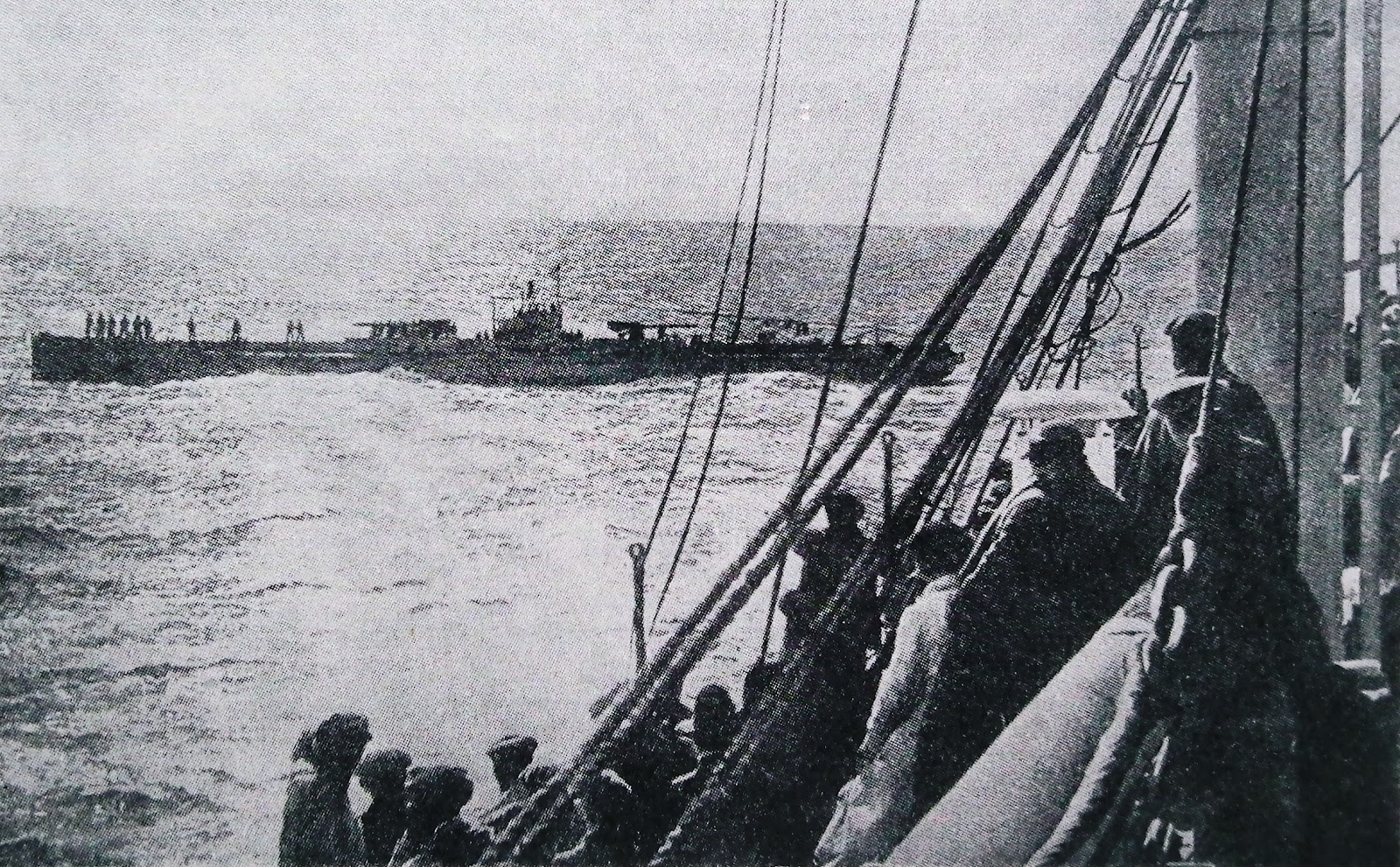
A German U-boat holding up a Spanish steamer
The Swedish steamer Hispania had a white and red zebra painting, indicating that it was entitled to sail through the  U-boat zone when departing the UK. 
Workers inspecting damage caused by a mine on the Swedish steamer Thyra in April 1919
In July 1917 the Swedish steamer Vanland was hit by a torpedo
In March 1916 the steamer Martha hit a mine field close to the Falsterbo reef, but could be towed to Malmö
Of course the Swedish losses were rather modest when compared to the losses suffered by the warfaring nations. Britain e.g. lost 2475 merchant ships and 670 fishing boats, and 15 000 British sailors lost their life during World War 1. 


(Source: Article by Axel Lindblad in the book Sveriges Sjöfart, published in 1921)

Thursday, 9 August 2012

Camouflage painting on ocean liners during World War 1

During World War 1 a military camouflage paint, also known as dazzle camouflage, was extensively used on navy ships and ships which e.g. were used for troop transports.

This is how Cunard´s RMS Aquitania looked in "razzle dazzle" paint: 


The Deutsche Ost-Afrika-Linie´s Feldmarschall had a somewhat different dazzle paint: 


The dazzle camouflage scheme consisted of a pattern of geometric shapes in contrasting colors, interrupting and intersecting each other: 

At first glance dazzle seems an unlikely form of camouflage, drawing attention to the ship rather than hiding it, but this technique was developed after the Allied Navies were unable to develop effective means to disguise ships in all weathers.
Dazzle did not conceal the ship but made it difficult for the enemy to estimate its type, size, speed and heading. The idea was to disrupt the visual rangefinders used for naval artillery. Its purpose was confusion rather than concealment. An observer would find it difficult to know exactly whether the stern or the bow was in view; and it would be equally difficult to estimate whether the observed vessel was moving towards or away from the observer's position.