Showing posts with label history. Show all posts

Thursday, 6 October 2016

In praise of buttons

Buttons are useful - and beautiful!


Here is a little bit about the history of buttons:

Buttons and button-like objects used as ornaments or seals rather than fasteners have been discovered in the Indus Valley Civilization during its Kot Yaman phase (c. 2800–2600 BCE)[1] as well as Bronze Age sites in China (c. 2000–1500 BCE), and Ancient Rome.
Buttons made from seashell were used in the Indus Valley Civilization for ornamental purposes by 2000 BCE.[2] Some buttons were carved into geometric shapes and had holes pierced into them so that they could be attached to clothing with thread.[2] Ian McNeil (1990) holds that: "The button, in fact, was originally used more as an ornament than as a fastening, the earliest known being found at Mohenjo-daro in the Indus Valley. It is made of a curved shell and about 5000 years old."[3]
Functional buttons with buttonholes for fastening or closing clothes appeared first in Germany in the 13th century.[4] They soon became widespread with the rise of snug-fitting garments in 13th- and 14th-century Europe. (Wikipedia)

Thursday, 6 February 2014

The 1905 Gordon Bennett Cup motor race

M. Clementel, the cabinet minister in charge of the French colonies,
congratulates the winner.

The 1905 Gordon Bennett Cup was a major motor racing event held on 5 July on the Auvergne Circuit in France. The race, with 18 entries from six countries, was won by the French driver Léon Théry, who had been the winner already in the 1904 race.

Théry, who drove a 96 hp Richard-Brasier, drove the total distance of 549.4 km in seven hours, 2 minutes and 42seconds, an average speed of 77.85 km/h.

Two Italian entries, Felice Nazzarro and Allessandro Cagno, both driving FIATs, finished second and third. Charles Stewart Rolls, the co-founder of the Rolls-Royce car manufacturing company, who drove a Wolseley, was the best British entry. He finished eighth.

German favourite Camille Jenatzy did not finish the race.

German favourite Camille Jenatzy (Mercedes), who had won the race in 1903, disappointingly was not able to finish the race.

Sunday, 2 February 2014

An Imperial Russian army "cook brigade" close to the front line during the Russo-Japanese war 1904-1905

"An army marches on its stomach."
   -- Napoleon Bonaparte


During the Russo-Japanese war 1904-1905 the Russian commanders were aware of Napoleon's words, and tried to organize the army food service as well as possible. The picture shows members of an Imperial Russian army "cook brigade" close to the front line somewhere in Manchuria.

Friday, 31 January 2014

Oskar Gripenberg, a Finnish general who commanded a Russian army in the Russo-Japanese war 1904-1905

General Oskar Gripenberg (1838-1916)


General Oskar Ferdinand Gripenberg was one of the Finnish officers, who served in the Imperial Russian Army during the Russo-Japanese war 1904-1905. (Finland was at that time an autonomous Grand Duchy under Russia). From 29 September 1904 to 29 January 1905 Gripenberg was the commander of the Russian Manchurian army.

This was the development that caused Gripenberg to resign as commander of the Manchurian army:

The Russian Second Army under General Oskar Gripenberg, between 25 and 29 January, attacked the Japanese left flank near the town of Sandepu, almost breaking through. This caught the Japanese by surprise. However, without support from other Russian units the attack stalled, Gripenberg was ordered to halt by Kuropatkin and the battle was inconclusive. The Japanese knew that they needed to destroy the Russian army in Manchuria before Russian reinforcements arrived via the Trans-Siberian railroad.

The commander in chief, general Kuropatkin refused to give Gripenberg the support he had asked for, and in addition Kuropatkin ordered the Manchurian army to withdraw against the its commander's will. Military historians consider Kuropatkin's indecisiveness and organizational deficiencies in directing large-scale military operations as a major element in the Russian defeat.

Tuesday, 26 November 2013

St. Petersburg on Epiphany Day 1905: The Blessing of the Waters Ceremony Takes an Ominous Turn

The ceremonial Blessing of the Waters of the Neva.

The Blessing of the Waters on January 6 (January 19th on the Gregorian calendar), the Feast of Epiphany, was one of the most picturesque ceremonies in Imperial Russia. It took place in a temporary pavilion, erected on the edge of the Neva, right in front of the Winter Palace in St. Petersburg.

On Epiphany Day 1905 the ceremony took an ominous turn:

Tsar Nicholas II, members of the royal family and diplomatic corps attend the ceremonial blessing of the waters of the Neva River in front of the Winter Palace. This is a longstanding tradition celebrating the baptism of Christ in River Jordan transposed to a frigid Russian winter setting. A hole called the Jordan is cut in the ice of the river and the Russian Orthodox Metropolitan of Saint Petersburg immerses his cross in it, blessing and purifying the water. People flock to collect the holy water which is believed to have protective and curative powers.
The Tsar and some of the dignitaries observe the blessing from an elegant pavilion built overlooking the river, while the Tsarina, Grand Duchesses and members of the diplomatic corps watch from the windows of the Winter Palace. The blessing is marked with a military gun salute.

This year, however, the ceremonial gun salute has an unexpected bite. The 17th Battery of the First Horse Artillery of the Guard, one of the most aristocratic of corps in the Russian army, firing from Vasilyevsky Island in response to shots from the Peter and Paul Fortress, has among all the blank saluting cartridges at least one weapon loaded with live ammunition. That gun happens to be aimed right at the Imperial pavilion. A charge of grapeshot peppers the Jordan, injuring one police officer and snapping the flagpole of the Marine standard. The shot also breaks four windows in the Window Palace, where the Tsarina and company stand. Nobody is harmed, but the Tsar’s mother is sprinkled in broken glass.
The official story is that this was negligence, an accident caused when the artillery was not properly cleaned after target practice two days earlier. It’s not a satisfying explanation. The guns can only take a single charge at a time, so how come nobody noticed there was already something in there when they attempted to charge the saluting cartridges on the day of the ceremony? Also, ceremonial salutes aren’t generally aimed right at the Emperor.
On the other hand, any artillery expert would know that grapeshot is not an effective tool of assassination when it has to cross a river to reach its intended target. If one of the soldiers of the battery had been attempting the life of the Tsar, surely he would have loaded the gun with something that had a chance of working. One the lead pellets lands not three feet away from the Tsar, but it’s unlikely it would have harmed him beyond a contusion had it made contact.

Thursday, 24 October 2013

A Russian prisoner of war in 1905

Whoever took this picture of a Russian prisoner of war in the 1904 - 1905 Russo-Japanese war, was a in my view a good photographer:

A Russian POW and his two Japanese guards in 1905.

Monday, 21 October 2013

A statue of a Swedish king in Karlskrona

When I saw the statue of the founder of the Naval City of Karlskrona, king Charles XI (Karl XI), during my visit in August, my first thought was that some important renovation work was being done.


However, soon I learned that I actually saw a work of art surrounding the king. It was the Swedish artist and landscape architect Monika Gora's piece "See what the king sees".

Later I noticed that she has made similar "installations" in e.g. Malmö and Helsingborg.

Sweden is full of old cities and towns, with statues of royals and other dignitaries. Which means that there is work to do for Gora and other contemporary artists ...

I for my part prefer to look at Charles XI and the rest from the street level:

Charles XI in Karlskrona
(image by Wikipedia)
 

Wednesday, 16 October 2013

Sunday, 8 September 2013

The Historic Sea Fortress Suomenlinna in Helsinki

The Suomenlinna ferry on its way to the fortress islands.

Situated on a group of islands off Helsinki, Suomenlinna (Sveaborg in Swedish) was built during the Swedish era as a maritime fortress and a base for the Archipelago Fleet. Work on the fortress was begun in the mid-18th century. Today, it is a UNESCO World Heritage Site and one of Finland’s most popular tourist attractions. Suomenlinna is also a district of the city of Helsinki, with a permanent population of more than 800.
The official Suomenlinna website.


Every time I visit Helsinki, I take the ferry to my favourite location in the city, the historic Suomenlinna (Sveaborg in Swedish, Finland's other official language) sea fortress. Below are some of my pictures from my latest visit, last week:

 This monument marks the tomb of the founder of the fortress, count Augustin
Ehrensvärd. The monument, which was designed by King Gustav III himself,
bears the inscription: "Here lies Count Augustin Ehrensvärd, surrounded by his
work, the Fortress of Sveaborg and the Fleet."


Thursday, 15 August 2013

The Naval Port of Karlskrona - A Unique UNESCO World Heritage site


"Karlskrona is an exceptionally well preserved example of a European planned naval town, which incorporates elements derived from earlier establishments in other countries and which was in its turn to serve as the model for subsequent towns with similar functions.  Naval bases played an important role in the centuries during which naval power was a determining factor in European Realpolitik, and Karlskrona is the best preserved and most complete of those that survive."

Justification for including the Naval port of Karlskrona as a UNESCO World Heritage site
 

For anybody interested in naval history, and ships in general, a visit to the Swedish Naval port of Karlskrona is highly recommended. The UNESCO World Heritage list description is a good introduction to the history of this unique naval center:

The naval port of Karlskrona was founded in 1680, at a time when Sweden was a major power whose territory included modern Finland, Estonia, Latvia, and parts of north Germany. The first step towards domination of the Baltic came when Sweden secured direct access to the North Sea ports and broke Danish control over Öresund Sound, the key to Baltic trade. When peace with Denmark was declared in 1658 with the Treaty of Roskilde, Skåne, Blekinge, and Gotland became Swedish territory.
A garrison and shipyard were installed at the small port of Bodekull, renamed Karlshamn in honour of King Karl XI. However, after a short Danish occupation (1676-79), it was recognized that this was not the ideal site for a naval base, and so in 1680 Karl XI issued a charter for the foundation of a new town in the east of Blekinge on the islands of Wämö and Trossö, to be known as Karlskrona and to serve both as a port and as a naval base. Tradesmen and merchants from this hitherto Danish area were forced into the new town by the withdrawal of their charters from the established towns of Kristianopel and Ronneby, and the region was progressively assimilated into Sweden.
The naval installations that developed at Karlskrona, beginning with a shipyard and storage facilities, were initially supervised by Erik Dahlbergh, Quartermaster General, responsible for the defences of the Swedish kingdom. Naval architects and craftsmen were sent from Stockholm, and houses were built to receive them. The shipyard began with two building berths, two quays, two forges, and five warehouses; the first keel was laid down in December 1680 and the first ship was launched the following year.
Karlskrona became a seat of government in 1683, the year in which Dahlbergh drew up the definitive plans for the town and its fortifications. By the time Gustav III took the throne by means of a coup d'état in 1772 it had become the third largest town in Sweden. There was a frenzied burst of activity at this time, with the building of a large fleet (accompanied by renewed building activity in the town itself) aimed first at Denmark and then Russia. Gustav's military adventures achieved very little, and he was assassinated by his political enemies among the nobility, who resented his assumption of absolute power. The loss of Finland in 1809 saw the end of the Swedish imperial dream.
Despite the political decline of the country, Karlskrona continued as the main base for the Swedish navy. A number of modernization and expansion projects took place during the 19th and 20th centuries, to keep pace with developments in naval and military tactics and technology (although the shipyard was slow to adopt new technologies, with the result that wooden hulls did not give way to steel until the 1880s). World War II saw the modernization of some of the older fortifications and the installation of new facilities for defence against aerial attack. Since that time there has been a progressive diminution of activity in the naval area, though it still plays an active role in the Swedish defence system. The town has been damaged by fire, most severely in 1790. As a result, rebuilding of the destroyed buildings, numbering over 400, was carried out using stone. However, the original street layout was largely preserved.

 
The naval harbour is a fascinating mix of historic buildings  and
contemporary marine technology.

Many of the historic naval shipyard buildings are architectural masterpieces.
 
Old and new side by side.


The Royal Swedish Navy's Corvette Harnosand K33 (launched
in 2004) is probably in for service or refitting.


The corvette K12 Malmo was launched already in 1986.


One of the Royal Swedish Navy's high speed boats on its way to the
Karlskrona archipelago.
 
 
If you are not able to board one of the navy ships, you can visit the nearby fortress
 islands on board the Blekinge, the oldest Swedish passenger ship still in service.


The naval fortress at Drottningskär on the island of Aspö is an architectural masterpiece from
the Swedish Great Power period. It was an effective defense for the western side of the main fairway 
to Karlskrona. 

At some stage the commander of the fortress wanted a more comfortable place
to live in when on duty. The navy built this nice red cottage for him.

The main entrance seen through the bell "tower".

Part of the facade facing the sea.

The main walls are about five meters thick.


The Kungsholmen fortress was built to protect the
eastern side of the fairway. It is still partially used by
the Navy.


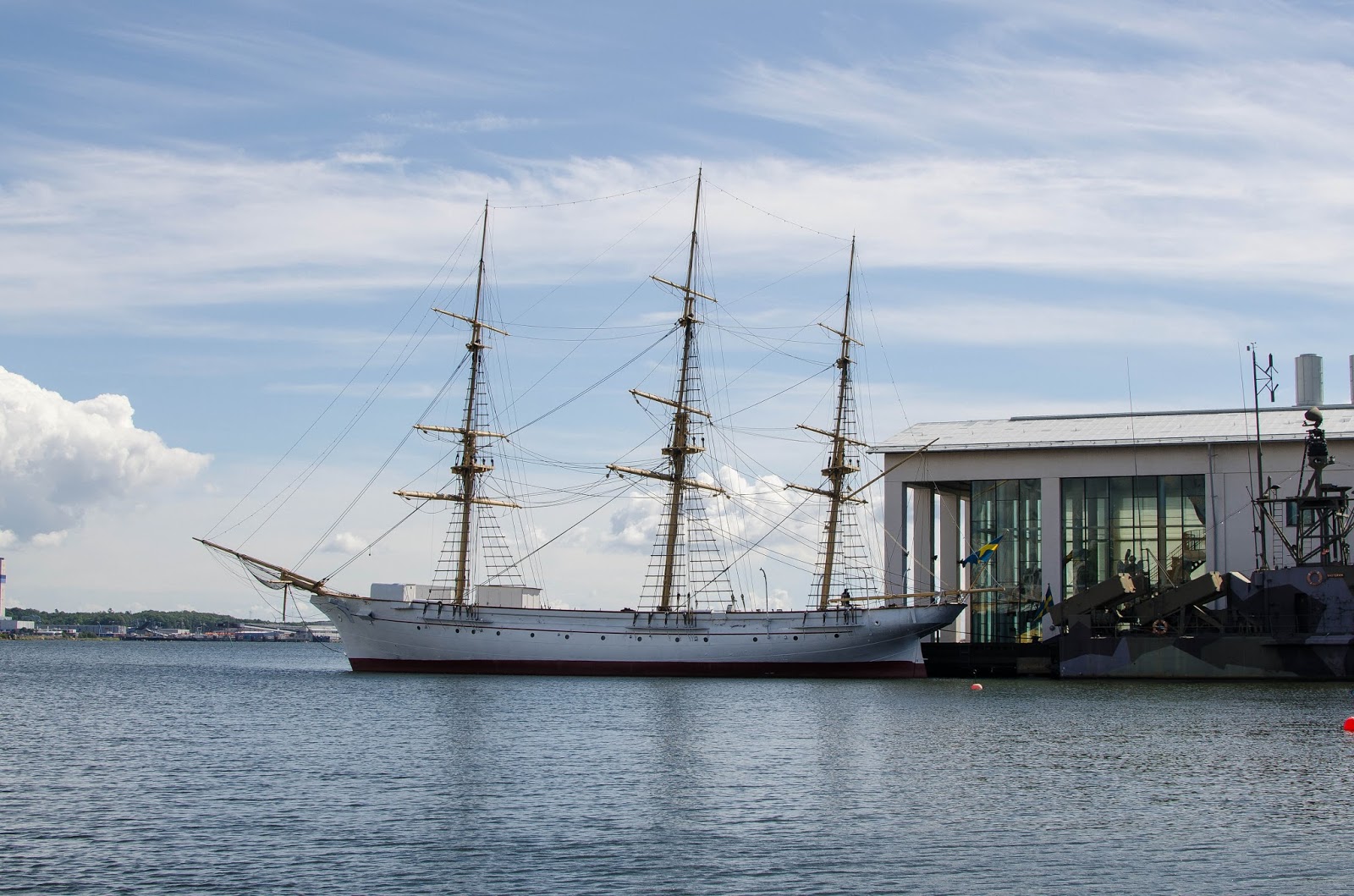
The fully rigged navy training ship  Jarramas was the last tall ship built
at the Karlskrona navy shipyard. 
 

The Jarramas is now one of the attractions at the excellent Naval Museum.


The retired missile boat Västervik R136 is also on display at the Naval Museum.

The Naval Museum has a fine Collection of figureheads.

Some of the museum collections are housed in these buildings.

A collection of traditional wooden boats at the Naval Museum.


The magnificnt Admiralty Church, built in 1685, is the largest wooden church in
Sweden. It was supposed to be a temporary building, but its replacement was
never built.


The Admiralty Church seen from the sea.


This wooden statue, depicting ex-constable Matts Rosenbom, who froze to death on New Year's Eve in 1717, is perhaps the most beloved of all the statues in Karlskrona. Rosenbom was found in the morning with his hand outstretched, his hat pulled over his ears, and a beggar's bundle on his back.  Since then, the wooden  Rosenbom has tipped his hat to all who give alms to the poor.


Gilbert Sheldon was a prominent shipbuilder of British descent, who worked in Karlskrona.
His grandfather emigrated to Sweden in 1655.
 

Historic naval architecture on one of the islands.


The Swedish Coast Guard offices.

The Palace-like residence of the Governor of Blekinge county (center left).
 
A closer look at the Governor's Residence.


Historic waterfront buildings in central Karlskrona.


Many of the modern buildings mix well with the old houses.


Two Baroque churches, the Fredrikskyrka (shown here) and the Trefaldighetskyrka
 (also known as the German Church) dominate the city's main Square. Both churches
are designed by the famous architect of the time, Nicodemus Tessin the Younger.
 

A detail of the German Church.


A view of the main naval Island, Trossö.


One of the bridges connecting two of the main islands.


The shipyard workers lived in small huts in the direct vicinity of
the naval shipyard. The picturesque wooden houses are
well taken care of by their contemporary owners.

Window flowers in one of the wooden huts.

A row of colorful huts.

The decorative entrance to a former workers' hut.