Good knives are important tools in the kitchen. Here is a detail of one of my favourite knives:
Catastrophes, wars, terrorism, ecological disasters, deadly diseases, poverty .... The list of tragedies - both personal and public - is endless. Every day and hour media, politicians, experts - and charlatans - bring us a never ending barrage of bad things. No wonder that many people feel depressed and weary. This blog tries - in a modest and personal way - to contribute to a more balanced view. After all, there is so much to appreciate and enjoy in life ...
Showing posts with label Japan. Show all posts
Wednesday, 11 January 2017
Kitchen knife
Wednesday, 17 February 2016
Coaling warships during the Russo-Japanese War 1904 - 1905
During the Russo-Japanese War (1904 - 1905) both sides used a British invention - Temperley overhead cranes - for coaling their warships while underway. The image from 1905 (coloured by me) shows a Russian navy ship receiving coal from a steamer with a Temperley crane.
Friday, 12 February 2016
Yokohama in the 1880s
Yokohama was an important port city already in the 19th century. This is a photograph from the 1880s, hand coloured by me:
Here is some additional information about Yokohama:
Yokohama,, officially the City of Yokohama, is the second largest city in Japan by population after Tokyo, and most populous municipality of Japan. It is the capital city of Kanagawa Prefecture. It lies on Tokyo Bay, south of Tokyo, in the Kantō region of the main island of Honshu. It is a major commercial hub of the Greater Tokyo Area.
Yokohama's population of 3.7 million makes it Japan's largest incorporated city.[2] Yokohama developed rapidly as Japan's prominent port city following the end of Japan's relative isolation in the mid-19th century, and is today one of its major ports along with Kobe, Osaka, Nagoya, Hakata, Tokyo, and Chiba. (Wiki)

Here is some additional information about Yokohama:
Yokohama,, officially the City of Yokohama, is the second largest city in Japan by population after Tokyo, and most populous municipality of Japan. It is the capital city of Kanagawa Prefecture. It lies on Tokyo Bay, south of Tokyo, in the Kantō region of the main island of Honshu. It is a major commercial hub of the Greater Tokyo Area.
Yokohama's population of 3.7 million makes it Japan's largest incorporated city.[2] Yokohama developed rapidly as Japan's prominent port city following the end of Japan's relative isolation in the mid-19th century, and is today one of its major ports along with Kobe, Osaka, Nagoya, Hakata, Tokyo, and Chiba. (Wiki)
Wednesday, 27 November 2013
The Great Buddha of Kamakura photographed in the 1890s
The Great Buddha is a monumental outdoor bronze statue in the city of Kamakura in Kanagawa Prefecture, Japan. The 13.35 m high (incl. platform) statue, which dates from 1252, is one of the most famous icons of Japan.
![]() |
| The Great Buddha of Kamakura, photographed in the 1890s. |
It appears that the western tourists posing in this 1890s picture of the Great Buddha, did not fully respect the text at the entrance to the grounds (or perhaps it was not there at the time?):
"Stranger, whosoever thou art and whatsoever be thy creed, when thou enterest this sanctuary remember thou treadest upon ground hallowed by the worship of ages. This is the Temple of Bhudda (sic) and the gate of the eternal, and should therefore be entered with reverence"
The grandeur of the statue inspired Rudyard Kipling to write the poem "The Buddha of Kamakura", which includes the following lines:
"And whoso will, from Pride released,
Contemning neither creed nor priest,
May feel the Soul of all the East
About him at Kamakura."
Contemning neither creed nor priest,
May feel the Soul of all the East
About him at Kamakura."
The Indian spiritual teacher Sri Chinmoy has given this description of the temple and statue in Kamakura:
"For me, it is one of the most peaceful places on earth. There are thousands of statues of Lord Buddha in existence, but the large statue at Kamakura embodies boundless peace. When you go there, no matter how restless you are, no matter how much your mind has been bothering you the whole day, no matter how involved you are in the hustle and bustle of life, as soon as you stand before the statue, all your inner turmoil is washed away. The statue embodies the most powerful peace you can ever imagine or feel."
A recent picture of the Great Buddha:
![]() |
| (image by Wikipedia) |
Wednesday, 6 November 2013
Danish steamer Prinsesse Marie - sunk by Russian auxiliary cruiser Terek in 1905
This is the Danish East Asiatic Company's (Danish: Det Østasiatiske Kompagni ) steamer Prinsesse Marie, which in 1905 was sunk in the China Sea by the Russian Imperial Navy's auxiliary cruiser Terek on June 22 1905. The Russians wrongly believed that Prinsesse Marie was carrying contraband to the Japanese.
Thursday, 24 October 2013
A Russian prisoner of war in 1905
Whoever took this picture of a Russian prisoner of war in the 1904 - 1905 Russo-Japanese war, was a in my view a good photographer:
![]() |
| A Russian POW and his two Japanese guards in 1905. |
Thursday, 3 October 2013
Two Japanese peace delegates in Portsmouth, New Hampshire, in 1905
The defeat in the 1904 - 1905 Russo-Japanese War was a major blow to Imperial Russia. Tsar Nicholas II chose a negotiated peace, brokered by American President Theodore Roosevelt (which earned him the Nobel Peace Prize). The Treaty of Portsmouth was signed on 5 September 1905 at the Portsmouth Naval Shipyard, New Hampshire.
The Japanese delegation at Portsmouth was led by Foreign Minister, Baron (later Marquis) Komura Jutarō - a Harvard graduate -, assisted by another Japanese nobleman, Baron Takahira.
Friday, 19 July 2013
The Russo-Japanese War (1904-1905) through the eyes of artists
The Russo-Japanese War (8 February 1904 – 5 September 1905) was "the first great war of the 20th century", and also the first war to be fully recorded by the international media. There was obviously a great demand for pictures from the remote war zone. Although there were some photographers in the area, usually they were not able to satisfy the demand for more "dramatic" shots, which the newspapers were most interested in.
That is why it was left for artists to provide the "action" shots and other more emotional, sometimes also patriotic, images. The accuracy of the artists' drawings of course varied. In some rare cases the war artists were themselves present at or close by the events, but often they had to rely on second hand accounts, some of which may not have been very accurate.
Below is a selection of illustrations, published in international media during the Russo-Japanese War:
That is why it was left for artists to provide the "action" shots and other more emotional, sometimes also patriotic, images. The accuracy of the artists' drawings of course varied. In some rare cases the war artists were themselves present at or close by the events, but often they had to rely on second hand accounts, some of which may not have been very accurate.
Below is a selection of illustrations, published in international media during the Russo-Japanese War:
| The Russian ambassador, baron von Rosen, leaving Tokyo after the outbreak of the war. |
| Empress Alexandra Feodorovna (Alix of Hesse) inspecting an ambulance train due to depart to the war zone. |
| The wife of a Russian officer, dressed as a Cossack in Mukden. |
| The first shot is fired by the the crew of a Japanese war ship. |
| Admiral Alexeieff, Russian Viceroy in the Far East, inspect the troops. |
| Japanese infantry advancing in Korea. |
| The way to the front was long. Cossacks made the journey a little bit easier to endure by singing about the glories of their forefathers - and about beautiful women. |
| Admiral Togo's fleet near Port Arthur. |
| Close combat between Russian and Japanese destroyers at Port Arthur. The ships were so close to each other that officers had to use their revolvers against the enemy. |
| "When the Petropavlovsk was destroyed". The drawing was made by an artist who was present when it happened. |
| "A Russian military ambulance on skis". |
| A Japanese soldier captured by the Russians. |
| "A giant at the mercy of the dwarfs". A Russian soldier captured by the Japanese. |
| General, count Tamemoto Kuroki, head of the Japanese First Army. |
| General Aleksey Kuropatkin, Imperial Minister of War. |
| General, baron Anatoly Stoessel, "The iron man of Port Arthur". "What I command, can be done". |
| Japanese cavalry in action. |
| The Japanese attack with bayonets. |
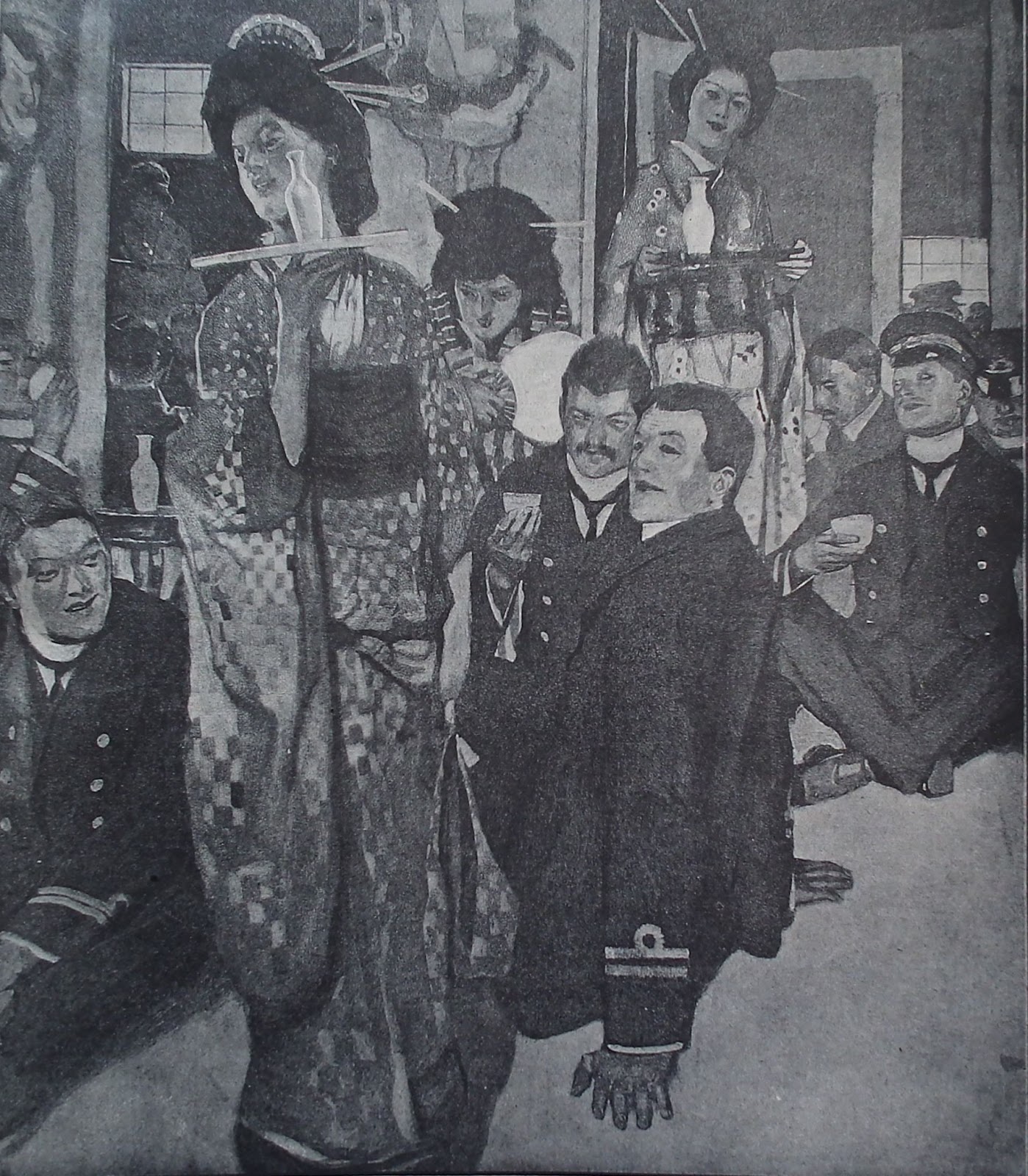
| Japanese naval officers on leave visiting a tea house in Nagasaki. Drawing by a Japanese artist. |
| "A welcome visit". A scene from the hospital for officers in Tokyo. |
| On board a Russian ambulance train. |
| Admiral Togo greeted by people in Tokyo after the fall of Port Arthur. |
| General Stoessel, together with his family, returning to Russia on board the steamer "Australia". The British artist Reginald Cleaver, who made the drawing, was also travelling with the "Australia". |
Wednesday, 17 July 2013
The Japanese steamer Hakata Maru and its commander in 1904
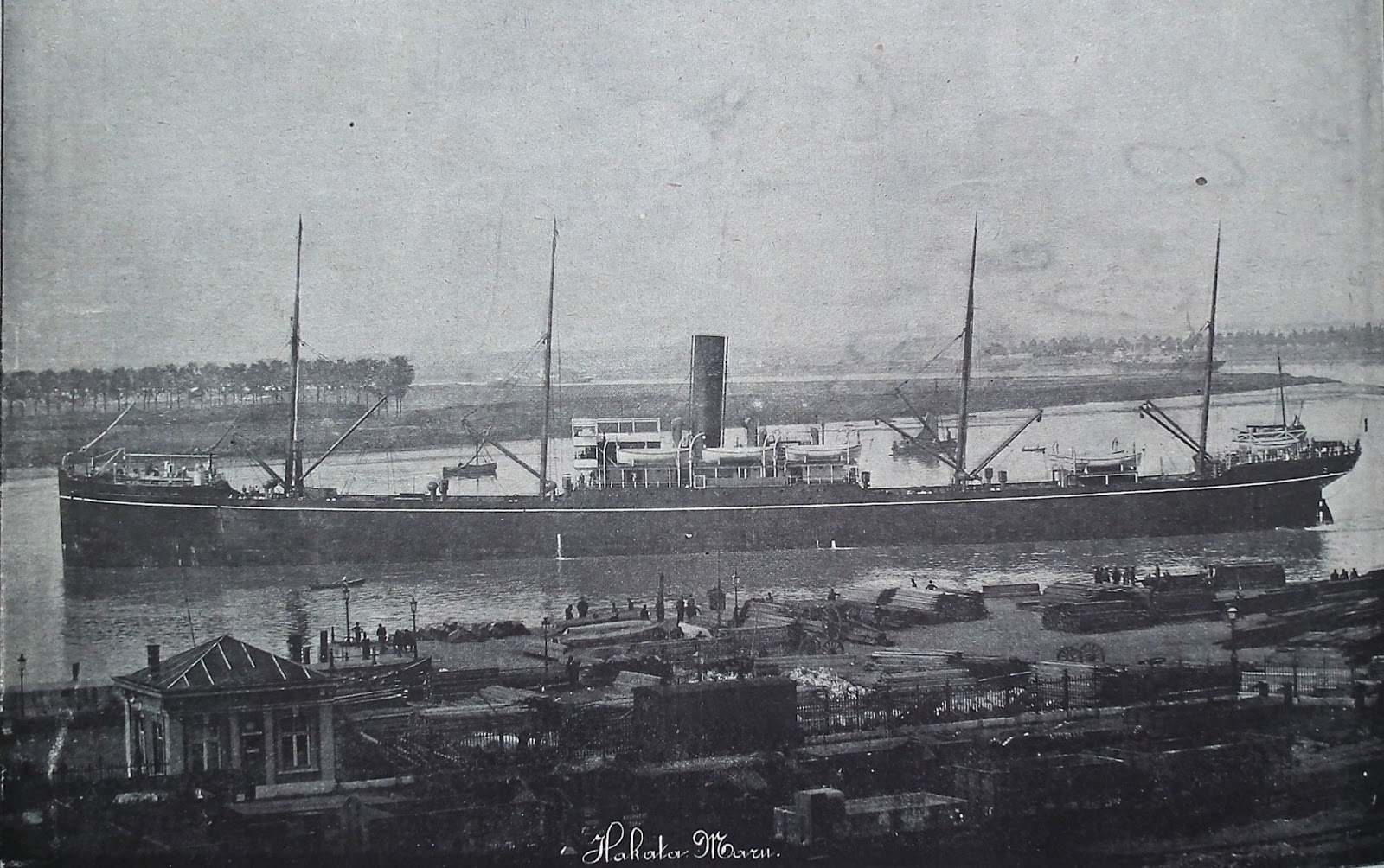
Recently I found these two 1904 photographs of the Japanase cargo/passenger vessel SS Hakata Maru and its commander, captain Sommer:
With the help of a little googling, I was able to find some additional information on the ship on the web:
The Hakata Maru was launched in 1897 at David and William Henderson & Co., Glasgow, for N.Y.K (Nippon Yusen Kaisha) Line's new European service. The 6161 gross tons, 135.6 m x 15.5 m ship had steam triple expansion engines, twin screw. Service speed was 12 knots.
The Hakata Maru, named after Hakata, one of the oldest cities in Japan (now part of Fukuoka) was scrapped in 1933.
Recently this painting of the Hakata Maru was sold for $3,675 at a US auction house:
| The Hakata Maru in 1904. Where to photo was taken, remains unknown to me. |
| Captain Sommer (a German?), the commander of Hakata Maru in 1904. |
With the help of a little googling, I was able to find some additional information on the ship on the web:
The Hakata Maru was launched in 1897 at David and William Henderson & Co., Glasgow, for N.Y.K (Nippon Yusen Kaisha) Line's new European service. The 6161 gross tons, 135.6 m x 15.5 m ship had steam triple expansion engines, twin screw. Service speed was 12 knots.
The Hakata Maru, named after Hakata, one of the oldest cities in Japan (now part of Fukuoka) was scrapped in 1933.
Recently this painting of the Hakata Maru was sold for $3,675 at a US auction house:
Monday, 15 July 2013
The origin of the Japanese people (as it was seen a hundred years ago)
The origin of the inhabitants has always been a much studied and debated theme in most countries. That is also the case with regard to Japan.
In the early 20th century researchers in Japan believed that the Japanese were not of pure Mongolian origin, but a mix of Mongols and Tatars, and that they thus were related to Finns and Turks. The Japanese scientists also believed that the indigenous Ainu people, living on Hokkaido and the Kuril Islands were the "purest" representatives of the original Finnish-Tatar population.
At the St. Louis World's Fair in 1904 the Japanese government, in accordance with the international habit of that time, exhibited a number of Ainu people.
The way the the Swedish Allers Familj-Journal in 1904 reported about the Ainu exhibited in St. Louis, is also typical for the time:
"The inhabitants of these islands are called Ainu, and Japan, which has a large presence in the St. Louis fair, has sent sent a number of these Ainu people, some older and some younger, to the exhibition. They are not very intelligent, and a sharp observer can easily see the similarity between these people and the Finns and the Tatars. Just look at the amazing resemblance of the old man in our illustration and the Russian author Leo Tolstoy. The researchers could really be right when saying that they are of Tatar-Finnish origin."
In the early 20th century researchers in Japan believed that the Japanese were not of pure Mongolian origin, but a mix of Mongols and Tatars, and that they thus were related to Finns and Turks. The Japanese scientists also believed that the indigenous Ainu people, living on Hokkaido and the Kuril Islands were the "purest" representatives of the original Finnish-Tatar population.
At the St. Louis World's Fair in 1904 the Japanese government, in accordance with the international habit of that time, exhibited a number of Ainu people.
The way the the Swedish Allers Familj-Journal in 1904 reported about the Ainu exhibited in St. Louis, is also typical for the time:
"The inhabitants of these islands are called Ainu, and Japan, which has a large presence in the St. Louis fair, has sent sent a number of these Ainu people, some older and some younger, to the exhibition. They are not very intelligent, and a sharp observer can easily see the similarity between these people and the Finns and the Tatars. Just look at the amazing resemblance of the old man in our illustration and the Russian author Leo Tolstoy. The researchers could really be right when saying that they are of Tatar-Finnish origin."
| Japanese Ainu people exhibited at the 1904 St. Louis World's Fair. |
| A portrait of Leo Tolstoy, published in the Allers Familj-Journal. |
Sunday, 14 July 2013
The Suez Canal during the Russo-Japanese War in 1904-1905
The Suez Canal was a strategically important seaway during the Russo-Japanese War in 1904-1905. The canal was a neutral zone under the protection of the British. According to e.g. Wikipedia, the British prevented the Russian Baltic Fleet from using the canal on their way to the war zone. However, if one is to believe two of the pictures below, published in the December 18 issue of the Swedish news weekly Hvar 8 Dag, at least some ships of the Russian Baltic Fleet sailed through the canal.
| Marine traffic in the Suez Canal in 1904. The ship in the middle of the picture flies the Royal Navy flag. |
| A ship belonging to the Imperial Russian Navy's Baltic fleet in the Suez Canal in 1904. |
| Provisioning one of the Russian Navy ships in the Suez Canal, 1904. |
Wednesday, 1 May 2013
A Swedish nobleman on a walking holiday in Japan in 1902
In 1902 the Stockholm illustrated monthly Ord och Bild published an article, "On foot in Japan", by the Swedish nobleman and naval officer S. Natt och Dag, who had been on a walking holiday in Japan together with two of his officer friends.
The article was illustrated by a number of photographs, which document people and places in the Japanese countryside in the beginning of the 20th century:
| A jinriksha. The Swedish travelers rented one to carry their luggage during their walking holiday . |
| The road between Nakasaki and Kanazava. |
| A Japanese nobleman. |
| The entrance to the temple in Kamakura. |
| Kanazava. |
| Shinto priests. |
| The statue of Buddha in Kamakura. |
| "The best hotel" (tea house) in Katase. |
| A Japanese bed. |
| Japanese toilette. |
Subscribe to:
Posts (Atom)


