There is not enough darkness in all the world to put out the light of even one small candle
Robert Alden
Candles are - fortunately - no more man´s main source of light. But there are still so many reasons to light a candle. Particularly here up in the the north of Europe, where days are short this time of the year. The warm glow of a candle brightens up the darkest day.
While living in Copenhagen some years ago, I noticed that the Danes have a very nice habit of lighting candles in their homes, even on days when there is no particular reason to mark a celebration. They just enjoy the the warm light a candle creates.
There seems to be a lot of uncertainties about the origin of candles. The Romans are credited with developing the wick candle, which they used for lighting their homes and places of worship. With the introduction of the light bulb in 1879 the the production of candles declined, but before long it started to grow again, when people learned to appreciate the beauty of light from living candles .
If you are interested in learning more about candle history, and candles in general, this site has a lot of interesting information:
http://www.candlecomfort.com/historyofcandles.html
(picture from beautifulfreepictures.com)
Catastrophes, wars, terrorism, ecological disasters, deadly diseases, poverty .... The list of tragedies - both personal and public - is endless. Every day and hour media, politicians, experts - and charlatans - bring us a never ending barrage of bad things. No wonder that many people feel depressed and weary. This blog tries - in a modest and personal way - to contribute to a more balanced view. After all, there is so much to appreciate and enjoy in life ...
Saturday, 20 November 2010
Santiago de Compostela
(Detail of map from 1648)
The 1000-year-old pilgrimage to Santiago de Compostela in northwestern Spain has always fascinated me - although I have never actually done it. But several of my friends have, and they all say it was worth the hardships encountered on the long walk which can take from six to eight weeks. I still nurture a hope to walk at least a small distance on one of the routes leading to Santiago de Compostela some time in the not too distant future ...
For all those, who plan to make the pilgrimage, there is a wonderful internet resource with a plethora of excellent advice and pictures. The site is well worth visiting even if you don´t plan to do the pilgrimage.
http://www.santiago-compostela.net/
(Detail of map from 1648)
Friday, 19 November 2010
Rita Hayworth as Gilda
There are lots of good films that I like, but only a handful of them are really special. One of them is Gilda with the stunning Rita Hayworth in the leading role. I think the IMD reviewer scotty12´s description of this film noir classsic from 1946 is very much to the point:
The 40s and 50s produced many alluring performances from beautiful and sexy actresses and Rita Hayworth's in Gilda is one of the most provocative of all. The film is good and quite deep, the male leads are better, but Hayworth's performance is simply stunning and unforgettable. She may not have been the most beautiful 40s actress (Gene Tierney and Veronica Lake were more classic beauties imo), but if you look closely her ability to show the sweet, the vulnerable, and especially the wanton, in women has not been bettered. Somehow her character gets under the male viewer's skin in the same way as it does to the male characters in the film.
Modern film femme fatales are a pale shadow by comparison, for example Linda Fiorentino or Sharon Stone. I'm not sure why. It could be either that nowadays allure is too much equated with sex or nudity (less tantalising than several dashes of suggestion) or maybe it's that present day equivalents are portrayed as hard as nails without the necessary mix of sadness and vulnerability.
Whatever, if you've never appreciated what the appeal of 40s noir is, this is definitely one to try.
Rita Hayworth´s private life was unfortunately not very happy. After several unsuccesful marriages she died in 1987 after having suffered from Alzheimer´s disease for many years. One of her former colleagues, president Ronald Reagan - who later himself was to suffer from the same disease - remembered Rita with these words:
"Rita Hayworth was one of our country's most beloved stars.Glamorous and talented, she gave us many wonderful moments on stage and screen and delighted audiences from the time she was a young girl. In her later years, Rita became known for her struggle with Alzheimer's disease. Her courage and candor, and that of her family, were a great public service in bringing worldwide attention to a disease which we all hope will soon be cured. Nancy and I are saddened by Rita's death. She was a friend who we will miss. We extend our deep sympathy to her family."
In Gilda - and many other films - Rita Hayworth will, however, continue to delight audiences also inte future. Here are two musical excerpts from the film:
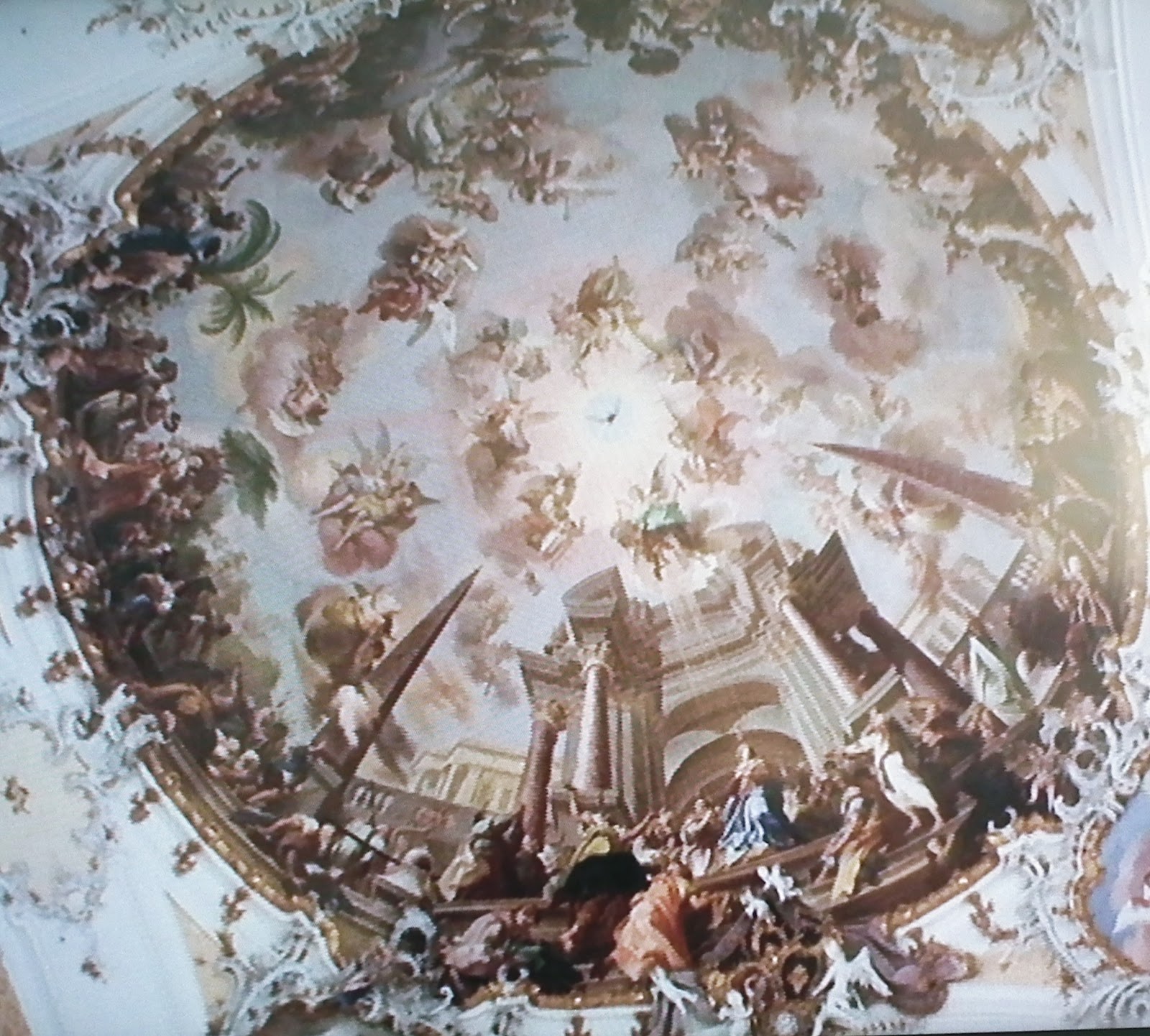
Vierzenheiligen - an architectural treasure in Bavaria
The baroque/rococo style church Vierzenheiligen near the bavarian city of Bamberg is one of Europe´s finest architectural treasures. A visit to this richly decorated pilgrimage church, designed by the great 18th century architect Balthasar Neumann is strongly recommended if you plan to visit Bavaria.
The eminent art historian and broadcaster Kenneth Clark, Lord Clark of Saltwood (1903-1983) describes in his autobiography the powerful impression Vierzehnheiligen and its architect made on him:
"Perhaps the happiest time that Jane (his wife) and I had together in the whole making of ´Civilisation´ was our visit to Germany to film the Rococo churches. I had been to some of them before without Jane, and it was a joy to see how rapturously she responded to them. But I had never been to the finest of them all, the Vierzehnheiligen.
What a masterpiece! This church and the palace of Würzburg tempted me to call Balthasar Neumann the greatest architect of the eighteenth century and, much as I love Gabriel, I will stand by my judgement. I believe that the Rococo churches of Bavaria are still underrated, not only as architecture, but in the discovery of a new truth, that the faithful may be persuaded by joy rather than fear."
Here is G.E. Kidder Smith´s description of Vierzehnheiligen (from the book Looking at architecture):
"A hundred years after Borromini's Quattro Fontane, the Late Baroque/Rococo in South Germany and Austria broadened architectural horizons even further. Here will be found architecture, sculpture, and painting vibrant with light and so closely woven together that it is often difficult to know where one art form begins and the other subsides. It is an architecture of joy, and if the cornucopia at times overflows, so be it.
"Among the most spritely creations of this short-lived period—the engines of the Industrial Revolution were beginning to herald a new culture—is Vierzehnheiligen, the Church of Fourteen Saints, by Johann Balthasar Neumann. Within its sober, straight-sided outer shell (on pre-existing foundations), color and luminosity bursts forth. Its inner walls define ovals and circles, its piers vanish into the decorated planes of the ceiling, an altar stands triumphant, while light floods in and color snatches the eye. (As opposed to seventeenth- century Early Baroque churches, daylight plays an essential role.) There is here—as throughout this South German cultural period—a hint of the 'confectionery' (Pevsner), but architecture is richer for this hedonism, and so are we."
More information here about Vierzehnheiligen.
PS
While in that part of Bavaria, don´t forget to visit Balthasar Neumann´s other masterpiece, the Würzburg Residenz with magnificent ceiling frescos by Giovanni Battista Tiepolo.
Raúl Shaw Moreno
I have always enjoyed Latin American music. My first memories of live Latin music go back to the early 60´s when the then famous Trio Los Paraguayos visited my home town. It was a great concert, but the fact that the concert hall was almost empty made me - and probably also the great Luis Alberto del Parana and his fellow musicians - very sad.
Much later I became aquainted with the music of another great Latin American singer, Raúl Shaw Moreno. Bolivian born Moreno joined the famous Mexican Trio Los Panchos in 1950 and became a wellknown name also in the US. Later he continued his solo career and remained a big star in Latin America. In 1983 he settled in Buenos Aires, where he died after a long illness in 2003. But his music lives on.
Here you can listen to three of his greatest hits:
In this radio recording from the Gran Palacio de Bellas Artes de Mexico you can hear Raúl Shaw Moreno both speak and sing:
You can still find Moreno´s CD:s at e.g. Amazon.com
Simple pleasures nr 2: Internet radio

Through the internet you can receive literally thousands of radio stations from all over the world. I used to listen to some of them on my PC. It is, however, a rather uncomfortable way of listening. That is why I recently acquired an internet radio receiver. And I have not regretted this small investment.
Now I am able to wake up to the news (including information about "staus" on the Autobahns!) presented by my favourite German language news station, Radio B5 Aktuell from the Bayerischer Rundfunk in Munich. Or I can listen to my former favourite Washington DC local music station WETA. And the the Danish DR has an excellent 24 hour classical music service called Allegro, which is part of my daily listening. The possibilities are endlesss.
A great number of internet receivers are available. Here you can find more info on the one I own:
http://www.argonaudio.com/sound/i-net/argon_inet_1.htm
Thursday, 18 November 2010
Simple pleasures nr 1: late evening walks in your neighbourhood
Having just returned from a late evening walk in my new neighbourhood, I realized that I had just found myself a new hobby - late evening walks in the neighbourhood or some other densely populated area.
I feel that I owe you, dear reader, an explanation.
This time of the year it gets pretty dark up here in the North of Europe already in the late afternoon. Fortunately, most villas in my neighbourhood have excellent interior lighting. When I strolled along the empty streets, it was difficult to avoid looking straight into people´s homes. It was fascinating to get a glimpse of how my neighbours have decorated the interiors of their houses. (In order to avoid any misunderstanding, please understand that I have no interest in prying into other peoples privacy - only to satisfy my natural curiosity for interior design). I was e.g. very pleased to note that the old house, which I have always admired, also had the most charming interior. Now I am already looking forward to my next evening walk, somehwat further away from my own place.
PS
And with evening walks there is the added benefit of feeling that its good for your health. Late evening walks also contribute to the general security of the neighbourhood. Burglars do not want to be seen.
Subscribe to:
Posts (Atom)