Showing posts with label museums. Show all posts

Friday, 18 July 2014

Kulturen in Lund - Sweden's second oldest open-air museum

Kulturen is Sweden's second oldest open-air museum after Skansen in Stockholm.
The main museum is located near the historic Lund Cathedral. The museum consists of a traditional museum together with an open air museum with over 30 different buildings.

The Nobleman´s House

The Burgher´s House

An alley in the Kulturen open-air museum

Interior from the Bosebo church

Thursday, 24 October 2013

The new Danish Maritime Museum in Helsingør - a world class attraction


It took a lot of time - and money - to build the new Danish Maritime Museum in Helsingør, which opened its doors to visitors only a couple of weeks ago. So it was with great expectations I entered the new museum this afternoon.

My first visit to the new museum confirmed what I had been hoping for: Helsingør now has another world class attraction in the immediate vicinity of Hamlet's legendary castle Kronborg.

The closeness to the UNESCO World Heritage Site Kronborg (500 meters) of course posed a great challenge to the architects. The winners of the design competition, Danish BIG architects - with Bjarke Ingels and David Zahle as architects in charge - have integrated the Maritime Museum in the historic environment in a splendid way by locating it in the town's former dry dock.

Here is how the architects describe their work:

The Danish Maritime Museum had to find its place in a unique historic and spatial context; between one of Denmark’s most important and famous buildings and a new, ambitious cultural centre. This is the context in which the museum has proven itself with an understanding of the character of the region and especially the Kronborg Castle. Like a subterranean museum in a dry dock.

Leaving the 60 year old dock walls untouched, the galleries are placed below ground and arranged in a continuous loop around the dry dock walls – making the dock the centerpiece of the exhibition – an open, outdoor area where visitors experience the scale of ship building.
A series of three double-level bridges span the dry dock, serving both as an urban connection, as well as providing visitors with short-cuts to different sections of the museum. The harbor bridge closes off the dock while serving as harbor promenade; the museum’s auditorium serves as a bridge connecting the adjacent Culture Yard with the Kronborg Castle; and the sloping zig-zag bridge navigates visitors to the main entrance.

This bridge unites the old and new as the visitors descend into the museum space overlooking the majestic surroundings above and below ground. The long and noble history of the Danish Maritime unfolds in a continuous motion within and around the dock, 7 meters (23 ft.) below the ground. All floors – connecting exhibition spaces with the auditorium, classroom, offices, café and the dock floor within the museum – slope gently creating exciting and sculptural spaces.

The pictures below are primarily related to the architecture of the new museum. I will later return to the exciting exhibits.

The Kronborg castle is only 500 meters away from the underground museum.

The new Culture Yard cultural centre is the neighbour on the other side. The Maritime Museum
is located right behind the blue and white fishing boat in the picture.

You enter and exit the Maritime Museum through this steel bridge.

The entrance is wonderfully integrated in the old dry dock area.

Another view of the entrance/exit bridge.

A very nice feature is that you can follow the building process through a number of
large pictures on display.

The image on the left shows the closeness to the castle.

More construction images on display.

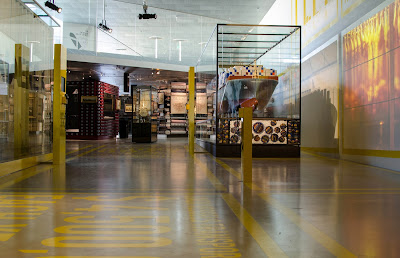
The exhibition spaces are boldly coloured and lighted.

On the right you can see a huge model of the world's largest container ship,
the Majestic Mærsk.

This beautifully designed hall should be perfect for lectures and other arrangements.

Some work is still being done on the upper side of these stairs.

The restaurant/cafeteria is wonderfully "minimalistic", with the old dry dock walls
clearly visible.
 
Flowers and pastry for the architects!


Thursday, 15 March 2012

The new Danish Maritime Museum to open in 2013

These beautiful fighureheads will soon find an new home when the Danish Maritime Museum next year moves out of Kronborg castle in Elsinore/Helsingør to resettle in its immediate vicinity.


Work on the new museum seems to be progressing well, although one can imagine that the construction work at the old Helsingør shipyard is not without its problems.


Here is some background information on the unique and exciting new museum:

The Museum will mirror Denmark’s historical and contemporary role as one of the world’s leading maritime nations. It will be placed in a unique building that has been designed by the company of BIG Architects, and it will be placed below ground level in and around the dry dock of an old shipyard.
The new museum wants to reach out to new groups of visitors who when they leave, will have a feeling of fascination, and new knowledge gained in a serious and entertaining manner.
The Dutch exhibition architects Kossmann.dejong will be in charge of the design of the new exhibitions. In recent years, Kossmann.dejong’s exhibitions have been particularly commended for their rich use of pictures and exciting designs, and for their ability to attract new audiences who are not accustomed to museums.
Since its foundation in 1915, the Danish Maritime Museum has been located at Kronborg Castle in Elsinore. This fine building, which is on the UNESCO World Heritage List, is, however, not the ideal setting for modern museum operations, and a potential relocation of the Museum had been discussed for years. The discussion culminated in 2003 when a report from the Danish Heritage Agency on the future of the Danish national museums, proposed moving the Danish Maritime Museum to Esbjerg and merging it with the Fisheries and Maritime Museum in order to create a strong and united maritime museum.
This idea was unpopular to many. The Museum’s subject field and collections are national and, for a major part, related to the Copenhagen area where the majority of shipping companies have their headquarters. As a result, a major study was implemented with the support of the Danish Shipowners’ Association, and the study indicated potential locations in the metropolitan area. The debate reached a positive conclusion in the autumn of 2005 with a decision that the new museum should maintain its historical attachment to Elsinore and Kronborg at the approaches to the Sound, and through this to the Baltic Sea. The Museum will be placed in Dock 1 of the former Elsinore Shipyard between Kronborg and Elsinore’s future main library and cultural centre in the old yard buildings.
The choice of location created the basis to continue a comprehensive fundraising effort, an architectural competition and clarification of the major project.
It was clear that the project was not only about relocation to a new building, but also about another weighting of the Museum’s research and information activities, so that the present time and contemporary maritime trade would take a more central place. It was also a requirement that the Museum should be designed and operated so that it would attract not only a larger number of visitors, but also a much broader user group with emphasis on young people and both sexes.
A significant asset for the Museum and its exhibitions will be the creation of unique architecture on the basis of the old dry dock from 1953 which was previously an important part of Elsinore Shipyard.

Even before the new building is opened, the Danish Maritime Museums´s existing collections at the Kronborg castle are well worth a visit!