Showing posts with label Paris. Show all posts

Thursday, 2 January 2014

The Swedish community in Paris on their way to meet King Gustaf V and Queen Victoria in 1908

On November 21, 1908, King Gustaf V and Queen Victoria, who were on an official state visit to France, met with the Swedish colony in Paris. Before the reception the members of the colony posed at the stairs leading to the residence of the French minister of foreign affairs. Many of the properly dressed ladies and gentlemen were probably members of the Cercle Suédois in Paris (founded in 1891). I think I also can spot a couple of people, who most likely were members of the fairly large Swedish artist community in Paris at the time.

PS (3.1.2014)
I noticed that the Cercle Suédois accepted ladies as members only in 1936. Thus what I wrote about membership applies only to the gentlemen.

The Swedish community in Paris on November 21,1909, on their way to meet their King and Queen.

Tuesday, 31 December 2013

"The latest fashion on the streets of Paris" (1908)

A trendy Parisian lady in 1908

Fashion trends in Paris were closely watched in Sweden already in the early 20th century. The weekly Hvar 8 Dag published this picture in one of its 1908 issues with the caption: "The latest fashion on the streets of Paris".

Tuesday, 14 May 2013

"The city of dwarfs" - A human zoo in Paris in 1906

 Dwarfs in the human zoo in Paris in 1906.

The Jardin d'Acclimatation in Paris, now a children's amusement park with a zoo, was founded in 1860 by Napoléon III and Empress Eugénie as a zoo. In 1877 the zoo was converted into  "l'Acclimatation Anthropologique", which until 1912 specialized in showing the customs and lifestyles of foreign, mainly African peoples. Nubians, Bushmen, Zulus and many other Africans were "exhibited" in the human zoo. These exhibitions were a great success, doubling the number of visitors.

Another popular exhibition was the "City of dwarfs" in 1906. The Swedish weekly Hvar 8 Dag included a brief account of the exhibition "concept":

"A rather peculiar exhibition will soon be opened in the Jardin d'Acclimatation. A colony of 300 living dwarfs has been assembled, for which a small city, with its own theater and church, etc., has been built." 


A dwarf greets a visitor in front of his "dwarf city" house . The door height was 1 meter.
A carriage with dwarfs coming from the dwarf city station.

PS

Fortunately, times have changed. This kind of human zoo is unthinkable now. However, to my  surprise, a Wikipedia article tells us that the concept of the human zoo has not completely disappeared:
Congolese village was displayed at the Brussels 1958 World's Fair.[15] In April 1994, an example of an Ivory Coast village was presented as part of an African safari in Port-Saint-Père, near Nantes, in France, later called Planète Sauvage.[16]
An African village was opened in Augsburg's zoo in Germany in July 2005.[17] In August 2005, London Zoo also displayed humans wearing fig leaves.[18] In 2007, Adelaide Zoo ran a Human Zoo exhibit which consisted of a group of people who, as part of a study exercise, had applied to be housed in the former ape enclosure by day, but then returned home by night. The inhabitants took part in several exercises, much to the amusement of onlookers, who were asked for donations towards a new ape enclosure. In 2007, Pygmy performers at the Festival of Pan-African Music were housed (although not exhibited) at a zoo in BrazzavilleCongo.[19]
Living history museums or living farm museums are somewhat reminiscent of human zoos. Living history museums seek to show patrons how people live in different times or places. Employees or volunteers dress up and perform activities of daily life in the way that another culture would. In America, living history museums showcasing pioneer life may demonstrate baking bread, raising and harvesting crops, and keeping chickens. Generally, these volunteers go home at night.

Monday, 29 April 2013

The 300th Anniversary Gala of the Paris Opera Ballet School on ARTE


The Paris Opera Ballet School has for three hundred years carried on its mission: to pass on its traditions to future dancers. The French-German television channel ARTE last night broadcast the spectacular 300th Anniversary Gala from the Palais Garnier  in Paris.


It was Ludvig XVI, the Sun King, who founded the ballet school 300 years ago.

The evening began with a new creation, "D'ores et déjà", by choreographers Béatrice Massin und Nicolaus Paul, which combined baroque and modern style. The piece was set to music by Jean-Philippe Rameau:


A extract from Gounod's Faust was one of the other highlights of this wonderful evening of superior dancing:


Television director François Roussillon should also be congratulated. He and his team did a marvelous job in bringing the action to the living rooms of - hopefully - millions of viewers. 


Saturday, 1 September 2012

People and places in Paris during the first years of the "Belle Epoque"

Place de la Concorde (drawing by Boudier)

During the second half of the 19th century, Paris was totally transformed. In 1852 Napoleon III commissioned Georges-Eugène Haussmann to devise a bold plan to beautify and modernize the city. Haussmann replaced shabby shacks with elegant six and seven story white stone buildings on wide, tree lined avenues and boulevards. He also created many beautiful parks and open places.


Lately some historians have concluded that baron Haussman´s role as urban modernizer has been somewhat overblown. In reality, much of what has been called "Haussmannisation" actually happened during the the Third Republic between 1872 and the 1930s, as the American historian Peter S. Soppelsa points out in his thesis "The Fragility of Modernity:  Infrastructure and Everyday Life in Paris, 1870 - 1914"

Simply put, much of what we think of as “Haussmannization”—even including road development—actually happened under the Third Republic, between 1872 and the 1930s. 
Historical memory of Haussmann is distorted because we confuse what he started with what he finished. He started the long, uneven process of modern infrastructural development in Paris, but he by no means finished it. 

Still, Soppelsa also recognizes Haussmann´s lasting legacy:

Surely the most famous of Haussmann's works are the boulevards, one of his most lasting contributions to Paris's history. While it remained unfinished in his career and his lifetime, his street network created a template that the Travaux de Paris would continue to follow into the 20th century.

During "La Belle Epoque" ( approximately 1890 - 1914) Paris became the chic center of international arts and culture, although there were many artists who decried the fact that Haussmann´s and his successors´renovation projects had destroyed the city´s medieval center. One of them was Charles Rabelais, who described his feelings in a poem:

Old Paris is gone (no human heart
changes half so fast as a city's face)…
There used to be a poultry market here,
and one cold morning… I saw

a swan that had broken out of its cage,

webbed feet clumsy on the cobblestones,
white fathers dragging in the uneven ruts,
and obstinately pecking at the drains…

Paris changes . . . but in sadness like mine

nothing stirs—new buildings, old
neighbourhoods turn to allegory,
and memories weigh more than stone 

Below is a small collection of photographs, drawings and etchings from Paris, which show people and places during the first years of "La Belle Epoque": 

Rue de Rivoli
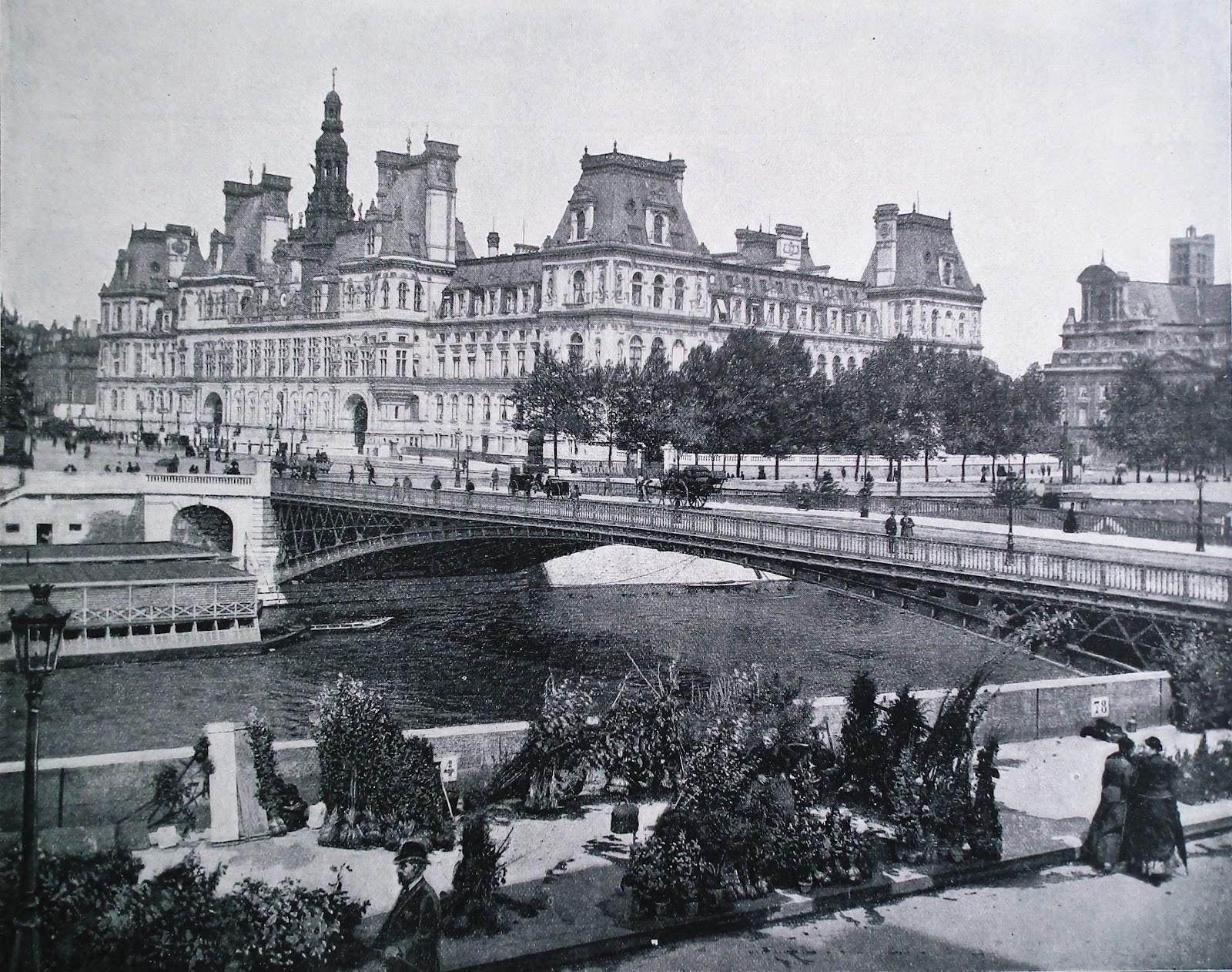
Hôtel de ville, the Paris city hall
Place de la Concorde
 Palais de la Bourse
Arc de Triomphe de l'Étoile
The Eiffel tower in the 1880s
Boulevard de la Madeleine
The Regiment is marching (etching by Rosseau)
Notre-Dame and the Île de la Cité
A scene from  La Rive Gauche, the southern bank of the river Seine 
(etching by Flórian, based on a painting by Béraud) 
rastaquouère (social upstart)
(etching by Rousseau, based on a painting by Forsin)
Destitution - "when you have not been able to pay the rent"
(etching by Rosseau, based on a painting by Geoffray)
A boulevardier -  a man who promenades through the fashionable city streets of
Paris, "a man about
town"
 (etching by Rosseau, based on a drawing by Forsin)
A Parisienne
(etching by Ruffe, based on a drawing by Béraud)
Qaui des fleurs (drawing by Boudier)
Palais Garnier, housing the Paris Opera (based on drawing by Boudier)
A scene from the Halles Centrales (etching by Derbier, based  on  a  painting  by Gilbert)