
Saturday, 2 March 2013
Stones in Øresund
When the water level is low, you can see that there are a lot of stones in Øresund ...


Big meets small in Øresund
Just after 5 PM today the Hongkong registered cargo vessel Ocean Shanghai (225 x 32 m) met the small Danish freighter Ann Rousing in the Sound.
 |
| Then the Danish freighter Ann Rousing (85 x 13 m) and Ocean Shanghai. |
Nordenskiöld's return to Stockholm in April 1880
 |
| The Vega in front of the Royal Palace in Stockholm in April 1880. |
The Finnish-born scientist and explorer Adolf Erik Nordenskiöld, who lived in exile in Sweden after 1857, made his most famous journey through the Northeast Passage between the years 1878 and 1979.
Nordenskiöld started his journey from Karlskrona on June 22, 1878 aboard the steamship Vega, a 43 meters long whaling ship, which had a 60 horse-power steam engine. The crew consisted of 21 men. In addition there were a number of scientists and officers. Swedish naval lieutenant Louis Palander was commander on the Vega.
 |
| The Vega crew. |
On September 2, 1879, Nordenskiöld reached reached Yokohama in Japan, and was celebrated as a hero all over the world. Although the voyage did not open the Northeast Passage through the Bering Strait for commercial traffic, it attracted people's imagination. This was the time when Jules Verne had published his book Voyages Extraordinaires and Stanley had found Livingstone in the African jungle.
 |
| The famous painting of A.E. Nordenskiöld by Georg von Rosen. |
On April 24,1880, Vega finally arrived in Stockholm. Nordenskiöld was duly feted, and King Oscar II, the financier of the voyage, made him a baron.
 |
| The return of the Vega in Stockholm on April 24 was a spectacular event. (image by wiki) |
After Nordenskiöld's death in 1901, the collection was according to his wish returned to his old home country Finland. Since 1902 it belongs to the University of Helsinki Library.
Friday, 1 March 2013
Windsurfing in Øresund on the first day of spring
Today was the first day of spring. In the Øresund region - or at least where I live - it was also the opening of the windsurfing season. The water is still quite cold, but that's no problem for surfers who are dressed properly.


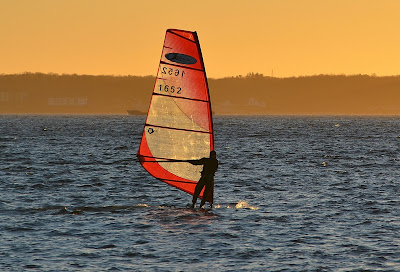
The crew on board the cargo vessel Silver Dragon (225 x 32 m), passing by just when the sun was setting, probably also observed the lone surfer.


The crew on board the cargo vessel Silver Dragon (225 x 32 m), passing by just when the sun was setting, probably also observed the lone surfer.

Pictures from the Russo-Japanese War 1904-1905
The 1904 - 1905 Russo-Japanese War was a disaster for the Russian Empire.
The pictures, published in the Swedish weekly Hvar 8 Dag in 1905, shed some light on what had happened:
The pictures, published in the Swedish weekly Hvar 8 Dag in 1905, shed some light on what had happened:
 |
| Russian officers attending a service before the battle of Mukden. The Imperial Minister of War, general Kuropatkin (x) , who is often held responsible for the Russian defeat, also took part. |
 |
| An abandoned Russian cannon. Beside the dead horses is a "moving bush", used by Russian sharpshooters. |
 |
| Russian "artillery" (made of tree trunks) in position in Tawan. Of course, it did not take long for the Japanese to conquer this "battery". |
 |
| Starving Russian soldiers arriving in Mukden while their officers were enjoying a delicious dinner at the railway station. |
 |
| General Nogi and his officers enjoying a fine lunch. On the table a Russian grenade, which had not gone off. |
 |
| The Japanese army provided plenty of rice for its soldiers. |
 |
| General Fuji (to the right) tried his luck at fishing at the Tai-tse river. |
 |
| General, count Kuroki, head of Japan's First Army, passes the time by trying out a captured Russian rifle. |
Marine traffic at the Hittarp reef
Yesterday afternoon I observed marine traffic in the Sound at the Hittarp reef:
 |
| The British container ship Cepheus J was on its way to Halmstad. |
 |
| The trawler Astrid Marie. |
 |
| The Swedish pilot boat was in a hurry. |
 |
| The man and the sea. |
Subscribe to:
Posts (Atom)