Catastrophes, wars, terrorism, ecological disasters, deadly diseases,
poverty ....
The list of tragedies - both personal and public - is endless. Every
day and hour media, politicians, experts - and charlatans - bring us
a never ending barrage of bad things. No wonder that many people feel
depressed and weary.
This blog tries - in a modest and personal way - to contribute to a more
balanced view. After all, there is so much to appreciate and
enjoy in life ...
This is the Danish East Asiatic Company's (Danish: Det Østasiatiske Kompagni) steamer Prinsesse Marie, which in 1905 was sunk in the China Sea by the Russian Imperial Navy's auxiliary cruiser Terek on June 22 1905. The Russians wrongly believed that Prinsesse Marie was carrying contraband to the Japanese.
HNMLS Groningen using its water cannon in Øresund.
The Royal Netherlands Navy's new offshore patrol ships HNMLs Groningen, HNMLS Zeeland and HNMLS Holland and the frigate HNMLS Van Speijk, which went southwards in the Sound last Friday, today returned, apparently on their way back home.
Groningen, the newest of the patrol vessels, gave a nice "water salute" when passing Helsingborg/Helsingør:
Stortorget("the big square") has since its founding in 1538 been the main square in Malmö. For a long time the 2,500 square metres also was the largest square in Scandinavia. Several notable buildings, including the Town Hall, surround the Stortorget. In the middle of the square stands the equestrian statue of King Charles X Gustav, who took Scania (Skåne) from the Danes through the treaty of Roskilde in 1658.
The square is often used for large scale public outdoor events, including the annual Malmö Festival.
This is how Stortorget looked in the year 1900:
And this is how Stortorget looked yesterday:
Here is a picture from another part of the square. On the right side of the yellow building is the neo renaissance style house built by the owner of the Leijonet ("The Lion) pharmacy in 1896:
The first railway station in Malmö was opened in 1856, coinciding with the opening of the Malmö - Lund railway. Since the opening the railways station has been rebuilt, extended and modernised several times to cater for changing needs.
A new train shed with four new tracks was built in 1891. This is how it looked at the turn of the century:
The Malmö railways station train shed in 1900.
Another photo, probably shot in 1897.
In 1924 architect Folke Zettervall designed a new train shed, which is still in use, although most of the train traffic has moved to the new lower level:
In 2000, both local and long-distance trains began running directly to Denmark via the new Öresund Bridge. Malmö became the centre of the new Oresund train regional railway system spanning eastern Denmark and much of southern Sweden, which in 2009 became integrated with local buses and trains in most of its service areas. The trains were, however, forced to reverse direction in Malmö’s terminal station, creating delays for anyone travelling to Denmark from Lund and beyond, and restricting the frequency of service, as each train had to both enter and leave Malmö by the same tracks. The opening of the City Tunnel in December 2011 made it possible for passenger trains to travel through the station, which had previously been a terminus, and most traffic shifted to the new lower level. All passenger traffic to Denmark now uses the tunnel, and most local trains continue to the new Triangeln and Hyllie stations even if they are not going beyond Malmö. The existing train shed was, however, renovated at the same time, to accommodate occasional long-distance trains including some services to Stockholm and the night express to Berlin, but several tracks were removed to make room for an extended bus terminal. (Source: Wikipedia)
This is how the Malmö Central Station train shed looks today:
The old train shed is nowadays mostly used by long-distance trains.
In one of the old halls there are now a number of restaurants and coffee shops.
The Gothic style St Peter's cathedral (Sankt Petri Kyrka in Swedish) is the oldest church in Malmö. Construction on it started in the beginning of the 14th century. The St Petri is very similar to the St. Mary's of Lübeck.
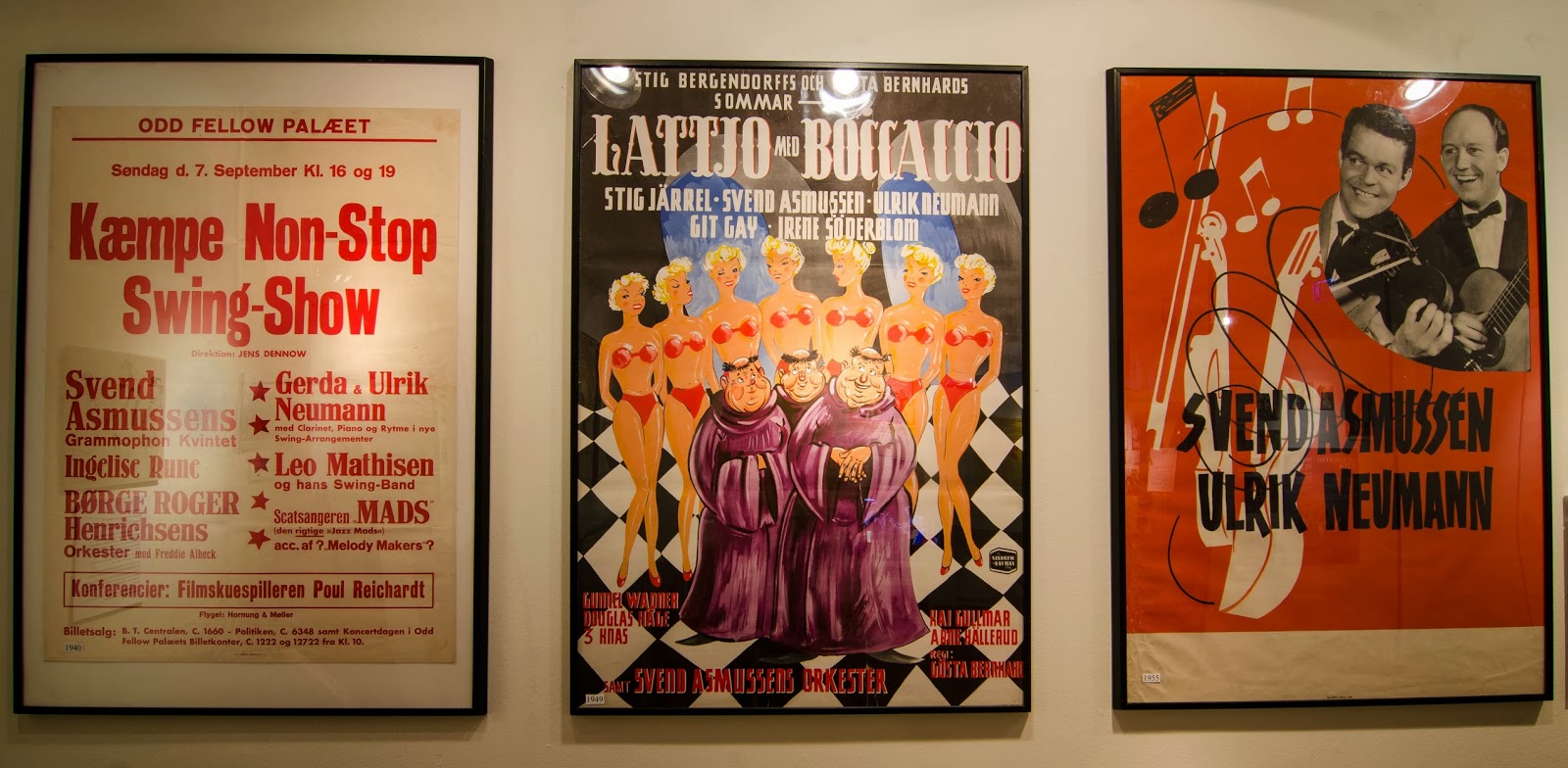
Three posters from the exhibition at the Theatre Museum.
There is a great number of musical families in the history of music. The best known is perhaps the Bach family. In Scandinavia the Danish-Swedish Neumann family is another fine example.
Right now you can see an interesting little exhibition, "The Neumanns - 150 years on the stage", at the Theatre Museum in Malmö.
The guitarist, singer, actor and composer Ulrik Neumann (1918 - 1994) is probably the internationally most well known member of the family. Together with his sister Gerda he toured successfully in Europe already in the 1940s.
In 1958 - 1961 Ulrik Neumann performed together with jazz violinist Svend Asemussen and Swedish singer Alice Babs in the Swe-Danes trio, in my opinion one of the finest European jazz- and entertainment ensembles ever to hit the stage.
Scandinavian shuffle became a signature song for the Swe-Danes:
Here Alice Babs and Ulrik Neumann perform a wonderful version of Hoagy Carmichael's "Two sleepy people":
Ulrik Neumann's Love Walz is a classic in the guitar repertoire:
Ulrik's son Mikael and Mikael's son Tobias are continuing the Neumann family's impressive 150 year old musical and stage tradition, shown in this "family tree", which is part of the exhibition at the Malmö Theatre Museum: