
Friday, 7 September 2012
Birds enjoying windy day in Øresund
The cormorants and the gulls seemed to enjoy the windy weather this afternoon at the Hittarp reef in Øresund:


Wednesday, 5 September 2012
The demolition of a home

This old house, beautifully located right on the seashore, had been empty for some time. It was not a particularly beautiful or otherwise very interesting house, so one expected that the new owners would tear it down and start building a new home on the site.
Still, when I saw the demolition men at work this morning, I felt a little bit sad. I did not know the people who had built and lived in the house, but there must have been a time, when they were thrilled about moving into their new home on the beach. For them the modest house probably was a small piece of paradise on earth.
Those people are now gone, and the house of their dreams joined them today.
A reminder of the transience of life ...
Hopefully the new home, soon to be be built on the now empty site, will be a nice one.
The Ocean Countess on its way to Aalborg

This is the classical cruise ship Ocean Countess in the Sound tonight. The ship entered service as the Cunard Countess already in 1976, but after several renovations it is still quite popular, particularly among elderly cruise guests. Due to its fairly small size, the Countess is able to visit many ports, which are out of reach for the large cruise liners.
The next destination after Helsingborg and Copenhagen is Aalborg.
A tanker and a schooner in windy Øresund weather
This day has been a reminder of the stormy weather in store for us later on in the autumn here in the Øresund region. According to marine weather reports gale force winds are expected in the northern part of the adjacent Kattegat area, this afternoon.
The chemical tanker Bit Oktania (134 x 22m) was today around noon heading north against the wind in the Sound. Her destination is Brofjorden in Norway:

Somewhat later this three masted tall ship was also on its way northwards, but much more slowly. The presumably rather modest size engine seemed to be struggling just a little bit in the brisk northwesterly wind. The schooner (?) was sailing without AIS signals turned on, so I was not able to identify it. If someone recognizes the ship, please let me know:

The chemical tanker Bit Oktania (134 x 22m) was today around noon heading north against the wind in the Sound. Her destination is Brofjorden in Norway:

Somewhat later this three masted tall ship was also on its way northwards, but much more slowly. The presumably rather modest size engine seemed to be struggling just a little bit in the brisk northwesterly wind. The schooner (?) was sailing without AIS signals turned on, so I was not able to identify it. If someone recognizes the ship, please let me know:

Tuesday, 4 September 2012
The full-rigged training ship Danmark in Øresund
 |
| The Denmark today sailed with 13 of its 15 square sails rigged. |
The full-rigged training ship Danmark, one of the world´s classic tall ships, today sailed through Øresund on its way from Dublin to Copenhagen. The ship was built in 1932 in order to replace the København, which was lost at sea, as Denmark´s principal merchant navy training ship.
The Danmark is operated by the Maritime Training and Eduction Centre, MARTEC, in Frederikshavn. The 77 x 10m ship has a crew of 15 and 80 trainees on board. She can be rigged with 26 sails with a total area of 1,632 m2, including fifteen square sails.
 |
| The Danmark meets M/S Havstrygeren, a traditional fishing boat, now serving the sport fishing community. |
The Danmark has an interesting history, which includes six years of service in the US during World War II:
During World War II, Denmark became occupied on April 9, 1940 while the training ship DANMARK was on a routine training mission in U.S. waters (Jacksonville, Florida). In agreement with the Danish Ambassador to the United States, the Honorable Henrik Kauffmann, Captain Knud L. Hansen placed his training ship at the disposal of the U.S. Government; however, neutrality prevented the acceptance of the offer until December 7, 1941 when Pearl Harbor was attacked.
From that point onward and until the end of the WW II, DANMARK and Capt. Knud L. Hansen served under the Stars and Stripes training some 3000 U.S. officer cadets. These young men received a first-class education in responsible seamanship under Capt. Knud L. Hansen’s capable leadership and strict discipline; later they would serve in the U.S. Navy.
The First Officer of DANMARK during the war was Knud Langevad, and he was in charge of training the U.S. cadets. He also convinced U.S. authorities of the value of learning seamanship on a tall ship, and following the war the U.S. Coast Guard purchased its well-known tall ship the U.S. EAGLE, to replace the DANMARK. This close Danish-American teamwork lasted until September 26, 1945, when DANMARK and her Captain were returned to the Danish Government with full honors. The Danish gesture is still remembered and appreciated in the USA.
After 6 years abroad the vessel returned to Denmark. Most of the cadets who left Denmark by the vessel in 1939 signed off in Jacksonville and during the war they did service on board allied ships About 60 cadets became American citizens.
Sunday, 2 September 2012
Sweden´s largest car carrier m/v Fedora in Øresund

This is the LCTC (Large Car Truck Carrier) m/v Fedora, the largest registered Swedish car carrier. The ship - named after Umberto Giordano´s opera with the same name - tonight sailed through Øresund northwards on its way from Gdansk to Bremerhaven.
The 228 x 32m ship, owned by Wallenius Lines and operated by Wallenius Wilhelmsen Logistics, has a capacity of 8,000 cars on its 13 car decks.
 |
| The m/v Fedora with the Kronborg castle in the background |
In addition to the excellent "parking facilities" on board, the Fedora also offers a good standard of comfort for the crew and possible passengers:
All accommodation areas are located on upper deck and
bridge deck, far away from the engine room. They have
a very high quality and a unique design with a two store
atrium with a top sky light. The ship also has a messroom,
TV-room/library, gymnasium, an outdoor swimming pool
and a sauna.
Read more about the Fedora here
Saturday, 1 September 2012
People and places in Paris during the first years of the "Belle Epoque"
 |
| Place de la Concorde (drawing by Boudier) |
During the second half of the 19th century, Paris was totally transformed. In 1852 Napoleon III commissioned Georges-Eugène Haussmann to devise a bold plan to beautify and modernize the city. Haussmann replaced shabby shacks with elegant six and seven story white stone buildings on wide, tree lined avenues and boulevards. He also created many beautiful parks and open places.
Lately some historians have concluded that baron Haussman´s role as urban modernizer has been somewhat overblown. In reality, much of what has been called "Haussmannisation" actually happened during the the Third Republic between 1872 and the 1930s, as the American historian Peter S. Soppelsa points out in his thesis "The Fragility of Modernity: Infrastructure and Everyday Life in Paris, 1870 - 1914":
Historical memory of Haussmann is distorted because we confuse what he started with what he finished. He started the long, uneven process of modern infrastructural development in Paris, but he by no means finished it.
Surely the most famous of Haussmann's works are the boulevards, one of his most lasting contributions to Paris's history. While it remained unfinished in his career and his lifetime, his street network created a template that the Travaux de Paris would continue to follow into the 20th century.
During "La Belle Epoque" ( approximately 1890 - 1914) Paris became the chic center of international arts and culture, although there were many artists who decried the fact that Haussmann´s and his successors´renovation projects had destroyed the city´s medieval center. One of them was Charles Rabelais, who described his feelings in a poem:
Old Paris is gone (no human heart
changes half so fast as a city's face)…
There used to be a poultry market here,
and one cold morning… I saw
a swan that had broken out of its cage,
webbed feet clumsy on the cobblestones,
white fathers dragging in the uneven ruts,
and obstinately pecking at the drains…
Paris changes . . . but in sadness like mine
nothing stirs—new buildings, old
neighbourhoods turn to allegory,
and memories weigh more than stone
Below is a small collection of photographs, drawings and etchings from Paris, which show people and places during the first years of "La Belle Epoque":
 |
| Rue de Rivoli |
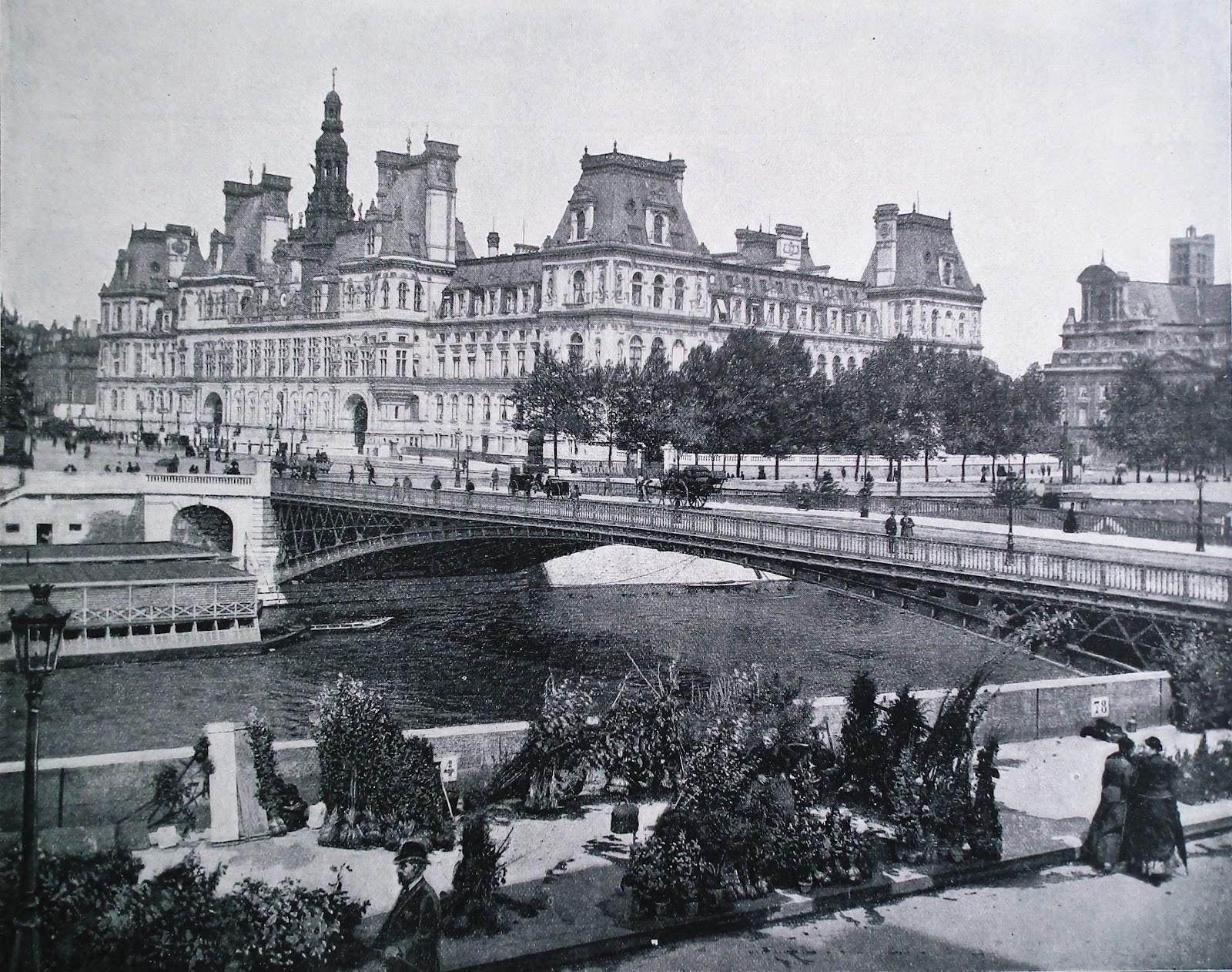 |
| Hôtel de ville, the Paris city hall |
 |
| Place de la Concorde |
 |
| Palais de la Bourse |
 |
| Arc de Triomphe de l'Étoile |
 |
| The Eiffel tower in the 1880s |
 |
| Boulevard de la Madeleine |
 |
| The Regiment is marching (etching by Rosseau) |
 |
| Notre-Dame and the Île de la Cité |
 |
| A scene from
La Rive Gauche, the southern bank of the river Seine (etching by Flórian, based on a painting by Béraud) |
 |
| A rastaquouère (social upstart) (etching by Rousseau, based on a painting by Forsin) |
 |
| Destitution - "when you have not been able to pay the rent" (etching by Rosseau, based on a painting by Geoffray) |
 |
| A boulevardier -
a man who promenades through the fashionable city streets of Paris, "a man about town" (etching by Rosseau, based on a drawing by Forsin) |
 |
| A Parisienne (etching by Ruffe, based on a drawing by Béraud) |
 |
| Qaui des fleurs (drawing by Boudier) |
 |
| Palais Garnier, housing the Paris Opera (based on drawing by Boudier) |
 |
| A scene from the Halles Centrales (etching by Derbier, based on a painting by Gilbert) |
Subscribe to:
Posts (Atom)